Tuesday, June 28, 2016

Educator Spotlight - Catrina Dillard

Catrina Dillard recently completed her Environmental Education Certification. Dillard is the volunteer and guest services coordinator at The North Carolina Arboretum in Asheville and is also currently serving as the membership coordinator for Environmental Educators of North Carolina, a non-profit professional organization for environmental educators.

For her community partnership project, Dillard worked with Lauren Pyle at the Western North Carolina (WNC) Nature Center to start Asheville's first Outdoor Play Club through an AZA (Association of Zoos and Aquariums) grant. The play club was supported by Kids in Parks, WNC Nature Center, The North Carolina Arboretum and the National Parks Service.  “I spent a great deal of time promoting and organizing events at various outdoor locations across the city. The goal was to create a play club in Asheville that promotes playing and learning outdoors while teaching families how to do so,” said Dillard.

As part of the program, Dillard facilitated several events including a nature art day at the WNC Nature Center, a kids hiking day at The North Carolina Arboretum, geocaching and letterboxing at Carrier Park and a river play day at the Davidson River. “The families I met were so excited to have a resource to get their kids outdoors in a fun, safe environment,” said Dillard. The program is now in its second year and the club’s Facebook page now has 244 members and serves as a resource for families to find fun outdoor activities across western North Carolina.

When asked about her favorite part of earning her environmental education certification, Dillard said, “I really enjoyed networking with colleagues at the workshops and all the great lessons. It was fun to take a series of classes at Montreat, Brevard College and Warren Wilson College because I was able to meet the pre-service educators and professors and gain inspiration from a whole new generation of environmental educators. I also enjoyed exploring the Environmental Education Centers across the state.” Dillard specifically notes a series of courses she took at Montreat College with Dottie Shuman, professor of Outdoor Education and Environmental Education and Tanya Poole, southern mountain education specialist with the N.C. Wildlife Resources Commission. “Dr. Shuman is an inspiration to her students and is a bright spot in the world of environmental education. She and Tanya Poole make a great team- so organized, fun and inspirational.”


Dillard says that the certification program changed the way she thinks about environmental issues. “I see the importance of environmental education in a well-rounded education. To create world-class citizens, we need to feed our children's minds, bodies and souls. The benefits of being outdoors is proven and can help balance our test-dependent school system. Having left the classroom to become an environmental educator, I have seen the benefits of learning in and about or environment. It is our duty as educators to teach our children why they need to create sustainable living and building systems and how to be good stewards of the planet. The certification process has made me feel highly qualified and given me the resources to be a better educator, in and outside the classroom,” said Dillard. 

Friday, June 17, 2016

AmeriCorps Member's Environmental Education Certification Project Engages High School Students to Help Monarchs

Corinne Fretwell is an AmeriCorps member serving with the Carolina Mountain Land Conservancy in Hendersonville. Like many AmeriCorps members who work on environmental outreach projects in North Carolina, she is also enrolled in the N.C. Department of Environmental Quality's Environmental Education Certification Program. 


                                         Corrine, center, with some of her
                      Carolina Mountain Land Conservancy 
AmeriCorps colleagues                   
Corrine gets some supervision from one of Deerwoode's year-round residents

The environmental education certification program requires a community-based partnership project, and Fretwell's is especially noteworthy. She worked to install a monarch waystation on land owned by Deerwoode Lodge and Cabins, a privately held resort located along the French Broad River south of Brevard, and also involved local high school students from the area in the project.

In 2003, 175 acres of the land were put into a conservation easement with the Carolina Mountain Land Conservancy (CMLC) by owner Bill Mays. But Fretwell felt the land had even more potential to serve as an ecological asset to help wildlife. Bill’s son, Matt Mayes, recounts seeing hundreds of thousands of migrating Monarchs visiting the property’s flowering fields, and in recent years he has shared the Monarchs with the family’s next generation; “I’ve gone out in the field with my daughter and caught them but it’s nothing near to the millions that used to come through here when I was a kid,” Matt shares.


Hopefully many more Monarchs will return as a result of Fretwell's project. She worked with more than 50 Brevard High School agriculture students, who with help from other CMLC AmeriCorps members planted 275 native milkweed plants on the easement. The newly planted milkweed is critical to Monarch populations since milkweed is the sole host and food source for Monarch eggs and caterpillars. The adult butterflies and other important pollinators will benefit from milkweed nectar when the plants bloom in late summer, as well as from the other planted flowers, which will extend the bloom time of the field from June through October.

The milkweed and other flowering plants were donated to the community project by CMLC. Tom Fanslow, Land Protection Director at CMLC obtained the plants from Monarch Rescue and founder Nina Veteto, who received funding for the plants from a U.S. Fish and Wildlife grant.

In keeping with the environmental education aspect, Fretwell
began each planting session with a short lesson about CMLC, land protection, habitat restoration, the Monarch life-cycle, as well as a demonstration of proper planting techniques. Students also received Monarch education materials from Monarch Watch, provided by Monarch Watch Conservation Specialist Joyce Pearsall who also joined in the planting day.

Carolina Mountain Land Conservancy is a non-profit land trust located in Hendersonville, NC. CMLC has protected more than 30,000 acres of lands that you love — and need — along the Blue Ridge Escarpment, French Broad River Valley, Hickory Nut Gorge, and beyond since its inception in 1994. For more information visit carolinamountain.org.

The N.C. Environmental Education Certification Program is administered by the N.C. Department of Environmental Quality's Office of Environmental Education and Public Affairs. Learn more about the program at www.eenorthcarolina.org  

NC Certified Environmental Educator's Project Revitalizes Public Space, Energizes Public Learning

Katie Boleware recently completed her North Carolina Environmental Education Certification, a program administered by the N.C. Division of Environmental Quality’s Office of Environmental Education and Public Affairs. Boleware currently works at the North Carolina Outward Bound School, but recently worked for the North Carolina Arboretum in Asheville where she completed her required community partnership project for the certification program. Located just south of Asheville, the arboretum is a 434-acre public garden which operates as an affiliate entity of the University of North Carolina system.

Boleware's project revitalized the Pollinator Garden, a public learning space at the arboretum. Recently the location became designated as a "Citizen Science Hotspot," in which 3rd-8th graders may come to record and upload ecological data to not only contribute to large scale scientific research, but also win cool prizes.


Boleware notes that "one of the aims of the project was to increase traffic in this little known public area by adding low-maintenance, low-cost, high-fun activities for younger siblings to complete while older siblings explore the Citizen Science Hotspot. Another goal was to beautify the space for field trips and summer camp groups that frequent the Pollinator Garden throughout the entire calendar year. Many varieties of vegetables were planted to harvest and cook with, host and feeder plants were added for local pollinators, and games such as tic-ta-toe and hopscotch were added to make the space generally more inviting. Through collaboration with the arboretum volunteer coordinator and United Way's Hands On! Day of Service, I organized volunteers from a local digital agency in Asheville to complete the labor required. We also began and ended the day with short discussions about the importance of garden-based environmental education, especially in our region of western North Carolina. " 

Katie's thoughts on her project are similar to many in the N.C. DEQ environmental education certification program who find it has a real, lasting impact on their communities. "My final project was very fulfilling. It allowed me to complete a long term goal at my previous workplace and leave a lasting impact on the educational space. I enjoyed collaborating with many community partners and organizing volunteers to complete a vision larger than I could have tackled on my own."


Katie relates that she also enjoyed the certification program’s field experience requirements, especially one spent at the Great Smoky Mountains Institute at Tremont. She also found the instructional workshops helpful in her professional development, noting that she felt the workshops "did a great job at helping me use an inquiry-based approach rather than consistently front loading every lesson. I also felt that the workshops increased my creativity when it came to coming up with new games and activities for getting my point across to a variety to audiences." 

So, consider visiting the North Carolina Arboretum in Asheville to view Katie's work, as well as beautiful plants, exhibits and other natural wonders. And why not participate in the N.C. Environmental Education Certification Program yourself? Learn more on the N.C. Office of Environmental Education and Public Affairs website. 


Thursday, June 16, 2016

Certified Environmental Educator Publishes Carolina Explorers Magazine for Families and Educators

Tamara Seymour, a freelance writer, graphic designer and interim teacher at a high school in Avery County recently completed her environmental education certification and in the process started a new magazine for families and educators. 

As part of her community partnership project for her environmental education certification, Seymour published Carolina Explorers Magazine, a family magazine about nature in North Carolina, from the mountains to the coast. Carolina Explorers is a fantastic field guide for educators and parents packed full of activities and wildlife investigations. Readers will find information on great places to visit and get outdoors, unique plants and animals in North Carolina, and even the best spots for sea kayaking. 


As part of the project, Seymour shared the small format magazine with classrooms, libraries and educators. Seymour has received a lot of positive feedback. "Readers enjoy the the publication and learning about North Carolina nature and new places to explore," said Seymour.


Seymour anticipates taking on a more formal role as an Earth and Environmental Science teacher for the 2016-2017 school year. In addition to her work as a publisher and educator, Seymour has helped manage a Fraser fir tree farm for the past five years and established a small nature center at the farm. 

When asked about the N.C. Environmental Education Certification Program Seymour said, “I think it is one of the best managed and most valuable programs for North Carolina and its educators. The program has helped me feel more comfortable in a teaching role, has improved my content knowledge, and has proved how effective (and fun) hands-on learning can be. I've collected and connected with, many valuable and credible resources I will use from now on.” 

The certification is offered through the Department of Environmental Quality's Office of Environmental Education and Public Affairs. For more information about the program, visit eenorthcarolina.org

For more information about Carolina Explorers Magazine, visit the website at ncexplorers.com


Tuesday, June 14, 2016

Interactive GIS Map Helps Educators Explore the Natural and Cultural History of the Tar-Pamlico Region

Staff from the DEQ Office of Environmental Education and Public Affairs recently had the opportunity to try out a new interactive GIS map developed for educators during a workshop hosted by UNC Institute for the Environment’s Environmental Resource Program.

Interactive GIS Map developed by the DEQ Office of Environmental Education and Public Affairs
Tracy Weidert, program coordinator with the office participated in the EGRET (Exploring the Geographical Region and Ecosystems of the Tar-Pamlico Watershed) Workshop which was designed to help educators explore the natural and cultural history of the Tar-Pamlico region, learn more about the EGRET curriculum and to explore ways the lessons could be integrated into their existing programs.

Weidert sees lot of potential for the interactive map because it allows users to explore the geographical and ecological features of their region with students and program participants. “With the map you can identify which river basin you live in, what type of soil is beneath your feet, examine the topography of your area, and more. The map also displays the state’s Environmental Education Centers of which there are over 200 in North Carolina,” said Weidert.

The workshop was offered to educators from state parks, science museums, nature centers and colleges and universities. The workshop is an extension of the EGRET Program, a year-long fellowship program to engage 5th grade teachers from the Tar-Pamlico river basin in hands-on, inquiry-based activities integrated across content areas and with the outdoors. 

Laura McCoy, Erica Connery, Toni Abernathy examining samples created during a live tar kiln demonstration

“We hope to make the program more sustainable by offering training to environmental educators in the field who can then support classroom teachers in their areas,” said Sarah Yelton, EGRET Program Manager, with UNC Institute for the Environment.

The professional development training included sessions on how to lead nature journaling programs that build observation skills and how to do citizen science in the schoolyard. Participants learned these skills and more at the two-day workshop, which was held at Goose Creek State Park. Park rangers and staff  were essential to helping facilitate the workshop sessions which also included: exploring swamp and marsh ecosystems; investigating Goose Creek by kayak; tar kilns + turpentine: how NC’s ecosystems built the state (with demonstration of a working tar kiln); and exploring ecosystem response to human activity.

More information about the EGRET program can be found at http://ie.unc.edu/egret/

To explore your ecological address using our new map, visit http://www.eenorthcarolina.org/resources-discover-ecoaddress.html


Monday, June 6, 2016

Free Film Screening Explores Carl Schenck’s Pivotal Role in Saving America’s Forests


The Department of Environmental Quality's Office of Environmental Education and Public Affairs has partnered with the North Carolina Museum of History to bring a new documentary about Carl Schenck and his role in our nation’s conservation history to downtown Raleigh, Friday, June 17 at 7 p.m.

The North Carolina Museum of History will present a free screening of “America’s First Forest: Carl Schenck and the Asheville Experiment,” the first in-depth documentary film about legendary forester and educator Carl Schenck. The film, which debuted on national public television in April, tells the story of the German forester who managed over 100,000 acres of woodlands at the Biltmore Estate in Asheville and established the first forestry school in the United States. He helped launch the American conservation movement.


Prior to the screening participants will have the opportunity to talk with local forestry education and outreach groups beginning at 6:30 p.m. The screening of “America’s First Forest” will begin at 7 p.m. followed a panel discussion and a Q&A session. The panel will feature James G. Lewis, executive producer of “America’s First Forest,” historian, and editor of Forest History Today; Brian Haines, public information officer of N.C. Forest Service; Joann Meyer-Cox, CF/CFA and owner of Meyer-Cox Forestry Consultants, LLC. Science comedian Brian Malow will serve as moderator.

Join us for this wonderful opportunity to learn more about Schenck’s amazing story and his pivotal role in our nation’s history.

Visit the Office of Environmental Education and Public Affairs website for more information. 


Thursday, May 19, 2016

New Pittsboro Farm & Forest Trail Open: EE Certification Projects Part of Project

Abundance NC, the Chatham County Partnership for Children and a host of community partners are excited to announce the opening of the new Pittsboro Farm & Forest Trail! The trail surrounds the Plant, an eco-industrial park on the edge of Pittsboro. Home to Piedmont Biofuels, Fair Game Beverage, Homs Bio-Herbicides, Abundance NC, Piedmont Biofarm, and several other sustainably-minded businesses. The Plant is a special, eclectic treasure of Pittsboro. The trail is located at the Plant, 220 Lorax Lane, Pittsboro. 

This trail has a special connection to the North Carolina Environmental Education Certification Program. Two Certified Environmental Educators completed projects that supported and were incorporated into the trail project. Marga Theelen partnered with the Wildlife Resources Commission, the Triangle Land Conservancy, New Hope Audubon, the Abundance Foundation and the Chatham County Partnership for Children to develop an explorative trail along the Wild Cherry Loop of the trail. The self-guided trail includes a companion brochure that helps visitors explore the ecology of the trail and explains forest succession and the functions of a constructed wetlands. Denise O'Gorman-Nowak also worked with the Chatham County Partnership for Children, Piedmont Biofuels and the Abundance Foundation to create a website for the trail which includes information about the trail and support resources and curricula to be used by educators, parents and caregivers. In the future, this website will serve an integral role for the trail community as the information hub to connect volunteers, educators and the public about events, workdays and all other aspects of the trail and it's programs. 

The rains subsided for the ribbon cutting...and left this nice present...
The.78 mile long trail, which will be open to the public from sunup to sundown, will provide a place for children and adults to be active in nature while learning about key themes of sustainable communities such as local food, renewable energy, the preservation of native plants, wildlife, natural resources and active living.  The trail surrounds four sustainably farmed vegetable fields, greenhouses, solar panels, and a newly planted vineyard; passes a constructed wetland, traverses woodlands with interesting specimen trees, and crosses a creek.


Summer Lunchtime Speaker Series Kicks Off Next Week

“Extragalactic Exploration: Galaxies and the Universe” will kick off the next Lunchtime Discovery Series next week. Dr. Patrick Treuthardt, assistant director of the Astronomy & Astrophysics Research Lab at the N.C. Museum of Natural Sciences will be the first featured speaker, May 25th at noon. 


This guest lecture series is hosted by the Department of Environmental Quality's Office of Environmental Education and Public Affairs and features professionals from a wide range of environmental and science backgrounds representing local and state agencies, colleges and universities and organizations throughout the state.

Attendees are able to learn about a variety of subjects first-hand and interact directly with some of the best experts in their respective fields. In some cases, participants even head outdoors to explore urban nature, local architecture and green rooftops! The presentations are provided as professional development opportunities for downtown employees and is open to the public.

Lectures are held in the office’s Environmental Literacy Center from noon until 1:00 p.m. The upcoming series includes presentations from Robin Moore from the Natural Learning Initiative with “Natural Play and Learning,” Dr. Adrian Smith from the N.C. Museum of Natural Sciences with “Social Insect Chemical Communication,” and Greg Morris from Walnut Creek Wetland Center who will lead an interpretive walking tour of the capital area’s tree species. The full line up can be found at http://www.eenorthcarolina.org/resource-center-elc.html

Wednesday, April 27, 2016

Environmental Educator Spotlight – Amy Kinsella

Amy Kinsella, a forest ranger with Holmes Educational State Forest in Hendersonville completed her environmental education certification this week. 

Kinsella is responsible for monitoring the health of 235 acres of state forest and for increasing forestry literacy for audiences of all ages. She conducts a variety of environmental education programs that occur on site, in schools and through year-long outreach programs including Envirothon, career days and festivals. 

The educational state forest offers workshops such as Project Learning Tree, and have outdoor instructor-led offerings like tree ID, birding, salamanders, and wildflower hikes. The state forest also hosts volunteer groups such as boy scouts, Eagle scouts and AmeriCorps members. 

Kinsella worked with an Eagle Scout group to complete a nature trail for an elementary school for her environmental education community partnership project. She assisted with identifying the trees on the trail and designating educational points along the trail. She worked with the local correction system to have engraved signs designed for identifying the trees on the nature trail. 

Amy feels that the certification program has changed her approach to teaching others. “We are in the process of evaluating our current program offerings and creating new programs that better meet curriculum standards. It was nice to see people who are passionate about providing a quality education program and to brainstorm about the evaluation process for program offerings," she said.

For more information about Holmes Educational State Forest visit North Carolina Educational State Forests and the Office of Environmental Education and Public Affairs

Monday, April 25, 2016

River Basin Publications Win Printing Industry Award

River basin education publications created by the N.C. Department of Environmental Quality won two awards at the 2015 PICA (Printing Industry of the Carolinas) Award ceremony in Concord on April 16. The N.C. Correction Enterprises Print Plant of Nashville received a Special Judges Award under the “campaign” category for their printing of the Discover North Carolina’s River Basins booklet and the Catawba River Basin and Yadkin-Pee Dee River Basin brochures. These publications are produced by the department’s Office of Environmental Education and Public Affairs.

The PICA Awards received more than 630 entries from 47 printing companies from across the state this year. The entries were reviewed by a panel of out-of-state judges using criteria that included clarity and neatness, sharpness of halftones and line drawings, richness and tonal qualities of color, paper and ink selection, ink coverage, difficulty of printing, effective contrast or softness, finishing, bindery, and overall visual impact.

PICA represents the graphic communications industry in North and South Carolina. Since 1931, this trade association has been dedicated to advancing the success of the Carolinas’ printing and imaging industry. Working together with Printing Industries of America, the world’s largest graphic arts trade association, PICA provides training, resources, and a voice of advocacy on both a state and national level.

The river basin publications are extremely popular with teachers and the public and receiving a PICA Award is wonderful news for an already successful program. The Office of Environmental Education and Public Affairs provides the Discover North Carolina’s River Basins booklet, brochures on each of the state’s 17 river basins and a poster sized map of the basins to educators. The program also maintains an interactive online map to find out which basin you live in and to find environmental education centers in your area.

PICA is headquartered in Charlotte, NC. For more information, visit www.picanet.org. More information about the DEQ River Basin program at http://www.eenorthcarolina.org/riverbasins.html


Friday, April 22, 2016

National Ocean Sciences Bowl Finals Held in Morehead City, NC

MEDIA ADVISORY

The text below features selections from the NOSB Media Advisory shared by N.C. Sea Grant.
Read the complete Media Advisory, with a list of teams and sponsors 

Top High-School Scholars to Compete in 19th Annual National Ocean Sciences Bowl


Contact: Allison Hays, 202-787-1644, ahays@oceanleadership.org
Posted Wednesday, April 20, 2016 as a courtesy to the National Ocean Sciences Bowl.

North Carolina Sea Grant is among the North Carolina sponsors for the event. Follow the events via Twitter: #NOSB16.NOSB


North Carolina is being represented at NOSB by
Walter Williams High School (Alamance County) Good luck!


 WHO: Winning teams consisting of four to five high school students from 24 regional competitions will compete in the 19th Annual National Ocean Sciences Bowl (NOSB), an education competition that tests students’ knowledge of ocean-related topics, which include cross-disciplines of biology, chemistry, policy, physics, and geology. The competition consists of buzzer-style, multiple-choice questions; longer, critical thinking-based team challenge questions; and the Science Expert Briefing, a mock congressional hearing where students present science recommendations on a piece of legislation, bettering their understanding on how science informs policy.


WHAT: The theme for this year’s NOSB Finals is “Our Changing Ocean: Science for Strong Coastal Communities.” This topic encompasses numerous scientific disciplines and encourages an increased understanding of the science needed to sustain strong coastal communities, including improving community awareness; addressing erosion and increasing coastal populations and development; restoring coastlines; protecting estuarine ecosystems and services; and improving coastal disaster projection, preparedness, and response. During the finals competition weekend, students will participate in a number of hands-on science activities, including a career mentoring event with leaders in the science field; a tour of Duke Marine Lab; and multiple field trips, including behind-the-scenes looks at the North Carolina Aquarium at Pine Knoll Shores, a shark tagging trip aboard the R/V Capricorn, and a coastal marsh cleanup at Fort Macon State Park. The top teams at the NOSB Finals will receive an all-expense paid award trip to various locations around the world to conduct scientific research with field experts.

 WHEN: April 21-24, 2016 — April 21: career event; April 22: field trips and opening ceremony; April 23-24: NOSB Finals Competition

 WHERE: Carteret Community College, 3505 Arendell Street, Morehead City, North Carolina WHY: Most high-school students do not have the opportunity to study ocean science as part of their formal coursework. To fill this void, the Consortium for Ocean Leadership, a nonprofit organization based in Washington, D.C., created the NOSB as an educational forum to encourage and support the next generation of marine scientists, policy-makers, teachers, explorers, researchers, technicians, environmental advocates, and informed citizens to be stewards of the ocean. Many past NOSB participants have pursued college degrees and careers in ocean science, helping to solve the growing environmental, economic, and security challenges facing our ocean and planet.

Monday, April 18, 2016

State environmental agency encourages public to take part in Earth Day events

Earth Day is Friday, April 22, and there are many environmental education events to mark the occasion throughout North Carolina. A wide variety of fun, family-oriented activities are planned that incorporate music, games and outdoor recreation. These opportunities are a great way to enjoy the outdoors and discover ways to care for our environment. To help you find events in your area on Earth Day and through April, the N.C. Department of Environmental Quality’s Office of Environmental Education and Public Affairs compiles an online calendar on their website, eenorthcarolina.org. Events can also be searched by city and zip code. 

Trail hikes, stream clean-ups, nature tours, music and more await those who want to explore and learn about North Carolina’s diverse environment. The public can also follow and share events, environmental education news and cool nature stories on Twitter and Facebook by following and using the hashtag #NCEarthDay. Many of these Earth Day events are also part of the N.C. Science Festival, which lasts through April 24th. For more information N.C. Science Festival events near you, see ncsciencefestival.org

DEQ employees will be volunteering their time on Earth Day as well. The Office of Environmental Education and Public Affairs is coordinating a DEQ Earth Day volunteer event on Friday, April 22. Raleigh area employees will be participating a stream clean up along a restored section of Rocky Branch that runs through N.C. State campus. Rocky Branch, a tributary of the Neuse, was once considered the most polluted stream in North Carolina. It now provides wildlife habitat, stormwater control, recreation and transportation along the Rocky Branch Greenway.


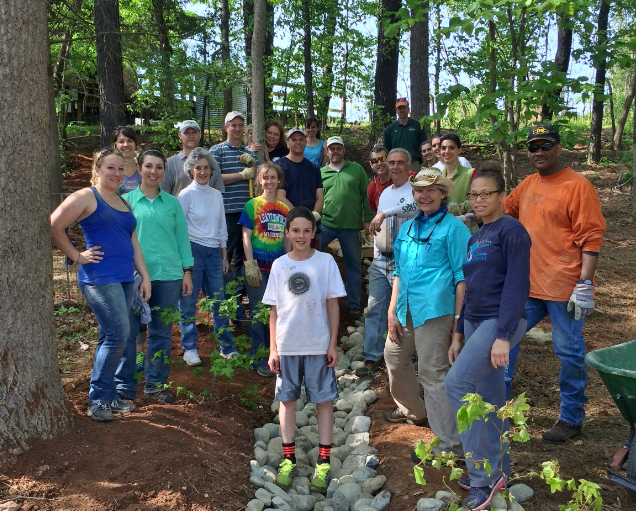
On Earth Day 2015, Department of Environmental Quality and Department of Natural and Cultural Resources employees and family members teamed up to create an artificial stream bed to improve drainage and stormwater control at Prairie Ridge Ecostation.
This year DEQ employees will volunteer to do a clean-up along Rocky Branch Creek and Greenway on the N.C. State University Campus.


Thursday, April 7, 2016

Environmental Education is a “Natural” Fit for Libraries, Says Syracuse U Professor


Marilyn Arnone, a School of Information Studies (iSchool) Research Associate Professor and Associate Professor of Practice with Syracuse University, was recently awarded a Carnegie-Whitney Grant by the American Library Association. Arnone now resides in North Carolina and recently became a North Carolina Certified Environmental Educator.

Arnone received the grant for a project that helps librarians and educators pair fiction and nonfiction books on environmental topics. In addition to being a valuable tool for teachers and librarians, the searchable paired booklist will assist higher education faculty who teach future librarians and will serve as a resource for promoting interest in reading environmental content.

This isn’t the first time Arnone has embarked on a large project to educate future librarians about the value of collaborating with nonformal environmental education programs and providers. As part of completing the North Carolina Environmental Education Certification Program, she produced the “Nature Librarians” website and video series that showcases what innovative community libraries and children's and youth services’ librarians are doing to provide their communities with nature-based activities and programs for children and families. “I loved doing this project and it gave North Carolina librarians some fresh ideas for nature programming,” Arnone said.

In addition to teaching her current courses, Arnone introduced a new course for the spring of 2016 on environmental programming for librarians.

When asked if obtaining her environmental education certification advanced her career, she said, “It helped prepare me to teach librarians in the Library and Information Science program at Syracuse University's School of Information Studies how to integrate environmental programming into their efforts to serve their communities.”

To read more about Arnone and her Carnegie-Whitney Grant, visit Syracuse University School of Information Studies website at https://ischool.syr.edu/articles/news/view/arnone-griffin-carnegie-whitney-grant-ala/

Tuesday, April 5, 2016

Science in the Great Outdoors

North Carolina's natural wonders are even more spectacular when you discover the science around them! 

This year, as part of NC State Parks 100 Year Celebration, State Parks has partnered with the North Carolina Science Festival to encourage students, adults and families to discover science in one of North Carolina’s beautiful state parks.

Kelvin, the NC Science Festival mascot, has already visited Mount Mitchell State Park. His visit reminds us that everyday citizens worked to preserve Mount Mitchell as our first park in 1916.  They understood the science enough to know that the unique alpine forest needed protection. Since then, dozens of other parks have been championed by everyday folks who discover the science of these places enough to know how special they are. 

My conservation heroes include Rachel Carson, Aldo Leopold, Margaret Nygard and A.B. Coleman. Chance are you know the first two; the latter are North Carolinians who gave us Eno River State Park and Merchants Millpond State Park by inspiring others to appreciate theses ecological wonders.  

The NC Science Festival and the efforts of several hundred NC Environmental Educators help ensure continued support for all parks - national, state, county, city, non-profit, and public-private partnership parks.

Science and Parks are everywhere.

Science and Parks are for everyone.

Science and Parks are FUN!

For a list of fun, do-it-yourself outdoor science experiments, visit 

Blog post by Sean Higgins, Interpretation & Education Manger, North Carolina State Parks


Thursday, March 31, 2016

Ranger Uses Environmental Education to Improve River Health and Educate Kids About the Environment


A park ranger from Hanging Rock State Park is making a difference in communities across North Carolina through environmental education. 
Darius Pollard completed the North Carolina Environmental Education Certification Program offered through the Department of Environmental Quality, which he began as an AmeriCorps member at New River State Park in Ashe County. 

As part of the community partnership component of his environmental education certification, Darius spearheaded a campaign to improve the health of the New River by engaging private landowners in efforts to restore easements or buffers along the river. Through a partnership with the National Committee for the New River, Darius arranged for funding to cost-share with landowners who wanted to restore their easements on the river. Darius’ efforts have not only helped with erosion and sediment pollution in the river but they have successfully educated property owners and engaged them in good management practices.

In addition to educating adults, Darius has had the opportunity to educate children through environmental education and interpretation programs at state parks. He credits the certification program for changes in his teaching approach. “Participating in the EE program changed my approach by increasing my knowledge but also by broadening my knowledge and interpretation styles for different audiences. Before the EE program, my approach to children was similar to that of adults but through this program I have learned that, for good interpretation, I must approach children in a much different way. Through workshops such as Growing up WILD, and Project CATCH, I feel much more comfortable approaching any age group,” he said.

There are certified environmental educators in every region of North Carolina. You can view programs offered by educators like Darius on the environmental education calendar at www.eenorthcarolina.org

The N.C. Environmental Education Certification Program is a professional development program for classroom teachers and nonformal educators. The program is administered by the Office of Environmental Education and Public Affairs in the Department of Environmental Quality. For more information about the program, visit www.eenorthcarolina.org


*Growing up WILD and Project CATCH are programs offered by the N.C. Wildlife Resources Commission. 

Friday, March 18, 2016

NC's Environmental Education Website – Notice Something New?

You may notice something new about the North Carolina Environmental Education website. The Office of Environmental Education and Public Affairs recently launched a “new look” for the website and although it has a new look, it still has the same great resources. 


The site which is set-up to serve as an online “hub” for environmental education programs, and facilities and resources receives approximately one million visits a year and provides a statewide calendar of events.

Behind the website’s success as an information clearinghouse is a unique partnership between eight southeastern states, Hawaii and Wisconsin to share information and provide environmental education resources. Some of the services provided through this partnership include a searchable directory of North Carolina's environmental education centers and organizations, a listing of grants and jobs, a statewide interactive calendar of events and a searchable resource database that links each resource to its provider.

The system also allows the participating states to share postings for grants, jobs, curriculum and other resources, greatly maximizing the capacity of each individual state’s educational outreach mission. Many of these shared services were provided free to the office through this collaborative grant.

Some examples of what you might be missing on the site:

A statewide listing of educational facilities
such as parks, nature and science centers, museums, botanical gardens, arboretums, coastal reserves, educational state forests, the NC Aquariums and Zoo.

A statewide calendar of events and professional development opportunities for educators

New resources such as the Egret Curriculum, a place-based curriculum designed to increase knowledge of current watershed science and environmental issues related to the Tar-Pamlico watershed in North Carolina and that aligns all lessons with 5th grade core curriculum and essential standards.

A statewide listing of jobs and internships in the field of environmental education.

Opportunities for grants and contests.

A thriving online community of educators through a statewide listserv, Twitter and Facebook

An opportunity to meet North Carolina’s Certified Environmental Educators

So check out the updated site and join the state's community of environmental educators. 


Tuesday, March 1, 2016

Sara Hallas Receives Conservation Communicator Award


Sara Hallas, coastal education coordinator with the N.C. Coastal Federation and a N.C. Certified Environmental Educator was honored for her outstanding environmental education and outreach efforts by the Hugh Hammond Bennett Chapter of the Soil and Water Conservation Society.

From the N.C. Coastal Federation's Coastal Review Online.


RALEIGH — Sara Hallas, coastal education coordinator with the N.C. Coastal Federation’s northeast office in Manteo, recently received the 2016 Conservation Communicator Award from the Hugh Hammond Bennett Chapter of the Soil and Water Conservation Society.


The award, presented Saturday in Raleigh, honored Hallas’ outstanding environmental education and outreach, including organizing the Coastal Environmental Educators Network, a coalition of environmental education organizations and professionals in northeastern North Carolina. The network’s mission is to create a sense of value for the region’s natural and cultural resources through partnership and networking. The network consists of more than 30 member organizations, including state, federal, university and nonprofit organizations.


To read the full story, visit the Coastal Review Online at http://www.coastalreview.org/2016/02/hallas-named-2016-conservation-communicator