Thursday, January 25, 2024

Educator Spotlight: Marguerite Bishop

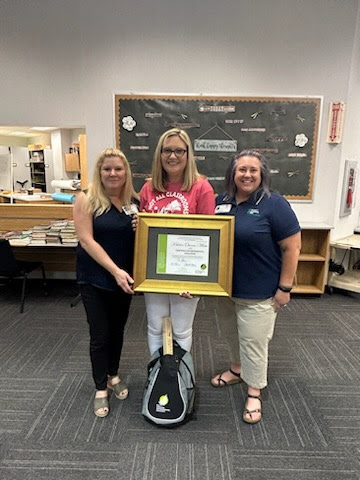
Marguerite Bishop, an instructor at Gaston College recently completed her NC Environmental Education Certification. Marguerite teaches general biology to science majors and non-majors. She also volunteers with local elementary schools to provide STEM-themed outreach.

Marguerite says that her favorite part of the certification program was visiting state parks with her family. “My kids were often tagging along when I was completing field experiences for my outdoor hours. We all have developed a greater love for salamanders, plants, the iNaturalist App and exploring through this process.”

When asked about an experience that stood out to her, she says it’s difficult to choose one. “All of the different experiences had value and have added to my knowledge of the natural world and how to introduce, teach and engage others with the world that surrounds them.”

For her community partnership project, she designed and installed a learning garden and outdoor classroom at Nashville Elementary School in Nash County. “I learned how to build a retaining wall and install fencing. I also gained an appreciation for a tractor and an auger so that postholes don't have to be hand dug. I think what made this project even more special is that it was accomplished during the beginning of COVID when everyone was so nervous and scared. It was great to have an outlet during this time that my kids could also help with to get us through a period of real uncertainty and feel like we were doing something good while living through this dark period.”

Marguerite says that participating in the program changed her approach to teaching. “As a biology instructor I often take my students outside and have them interact with the natural world to observe, question and analyze. Through this process I have learned about barriers that people might have to the outdoors and how to help guide students through these interactions to help make these experiences easier.”

She also says the certification changed the way she views environmental issues. “Through the EE certification program, I think about environmental issues with more hope. The program opened my eyes to a lot of people and programs that are trying to raise awareness of and mitigate the impact of environmental issues. I didn't know the community was so big before the certification program.”


The North Carolina Environmental Education Certification Program is administered by the N.C. Office of Environmental Education and Public Affairs in partnership with organizations and agencies across North Carolina. https://www.eenorthcarolina.org/certification


Educator Spotlight: Miranda Norlin


Miranda is the summer camp director for The Learning Community School and an instructor with Muddy Sneakers and she recently completed her NC Environmental Education Certification. In her personal time, she enjoys gardening and milling wood on the sawmill that she and her wife recently purchased. Miranda grew up exploring the creeks, woodlands and fields of Western North Carolina and enjoys sharing the outdoors with other people. “I love exploring the outdoors with people of all ages to build curiosity and connection to the outdoors.”
Her favorite part of the certification program was the Universal Design for Learning (UDL) in Environmental Education training she took through Environmental Educators of NC (EENC) and applying what she learned to her teaching practice. Miranda says the UDL course she took as part of the certification program changed her approach to teaching. “The UDL course shifted how I plan and structure my day and teaching. As part of it I developed my "planner banner" which is a visual organizer tool to allow students to see the plan for the day and share their priorities and interests while still allowing for flexibility on the part of the educator.” For her community partnership project, Miranda worked with Shining Rock Classical Academy to plan a nature trail on their campus. She used a survey and conversations with teachers to address their goals and concerns. She scouted out possible trail routes and recommended key species that could be identified by the students. She also provided recommendations for how the teachers can use the trail to teach their students. Miranda is grateful to be part of the wonderful community of environmental educators in North Carolina and looks forward to continuing to work with and learn from them through NCEE and EENC offerings.

The North Carolina Environmental Education Certification Program is administered by the N.C. Office of Environmental Education and Public Affairs in partnership with organizations and agencies across North Carolina. https://www.eenorthcarolina.org/certification

Tuesday, January 16, 2024

Educator Spotlight: Margot Lester

Margot Lester, CEO and owner of The Word Factory marketing agency, recently completed her NC Environmental Education Certification. The Word Factory has been in operation for more than 30 years and provides messaging and strategy consulting and brand journalism services, corporate and individual writing training, and advocacy work for national brands, universities and nonprofits.

Margot is an avid woods walker and beach lover, stormwater geek, interpretative signage nerd and nature writer. “My vocation and avocation came together when I discovered I could teach what I know about communications, writing and advocacy in the context of nature, the environment and climate action. It's still kind of hard to believe how well they dovetail.”

When asked about her favorite part of the program, Margot says she has met terrific people through the program and has made many friends. She also “ really loved getting to visit parks and other facilities around the state, like Singletary State Park and Gorges State Park. It not only fed my interest in education and interpretation, but it deepened my connection to my home state and its incredible natural resources.”

Margot notes that one of the certification experiences that stood out for her was the workshop on frog calls with Becky Savage and Karen Clark of the NC Wildlife Resources Commission. “Because I was driving all over North Carolina to get my site visits in, I could identify the herps in those areas. My visit to Gorges just happened to coincide with mountain chorus frog season. These little frogs have a seriously limited range in Clay and Cherokee Counties, and I was lucky enough to be staying with a friend right in the middle of their prime habitat. It was so cool to identify what we were hearing and to understand how rare the experience is for most people in the state.”

For her community partnership project, Margot created two nature journaling posters and a set of prompts for the Triangle Land Conservancy’s Williamson Preserve. One poster briefly reviews the benefits of being in nature and invites visitors to refocus their eyes, tune their ears and look for repeating patterns in nature. The other introduces visitors to Project Pando, a volunteer-driven farm that grows native trees that will be given for free to the public. “The project benefits public health by guiding visitors to slow down and immerse themselves further into nature, which enhances the mental and physical health benefits of being outside. The guided observations also create a connection to the preserve, explaining its role in native tree restoration. The posters inspire hikers who are curious about nature connection and journaling and may even motivate people to hit the trail to explore these activities and discover a new way to engage with the natural world.”

Margot says the certification program changed her approach to teaching. She says that the workshops provided by Environmental Educators of North Carolina (EENC) on inclusion, cultural sensitivity and accessibility really influenced her teaching. “I now do a people and place acknowledgment before my programs and include resources from a much more diverse group of experts. I plan my outdoor sessions with mobility in mind and try to optimize my materials for accessibility readers. I'm also exploring the possibility of translating my advocacy, climate action and nature journaling content into Spanish.”

The certification had an impact on the way she views environmental issues, too. “Interacting with people at events and trainings made me realize the need for empathy and hope in our communications about environmental and climate issues. Not toxic optimism or glossing over the real issues but sharing the hard parts and then showing tangible acts -- big and small -- that have impact. That's where the hope comes in. Doing my own work on these two topics helped me see the vital role of storytelling and personal narrative to break down barriers, bridge gaps and move people to action.”

Monday, January 8, 2024

Abigail Fuesler, Graduate Student at Western Carolina, Completes Her NC Environmental Education Certification

Abigail Fuesler recently completed her NC Environmental Education Certification. Abigail is the Executive Assistant to the Vice President for Academic Affairs at Brevard College, and a graduate student working on her M.S. in Experiential and Outdoor Education at Western Carolina University. Abigail serves on the Pisgah Area SORBA (Southern Off-Road Bicycle Association) Board of Directors and is also certified as a Leave No Trace Level 2 Trainer. In her personal time, she enjoys reading, puzzles, podcasts, road trips, game nights, mountain biking and canoeing. 

Abigail says her favorite part of earning her certification was the site visits. “The wonderful state parks in North Carolina have really innovative visitor centers, and I loved learning from experts about the topics they are passionate about.” She says the teaching component of the certification really stood out for her. “It was time consuming since I don’t have a classroom or a job that involves teaching regularly, but it is at the core of this certification.”

For her community partnership project, Abigail coordinated the 2022 Adventure Education Conference at YMCA Blue Ridge Assembly which drew 200 people, mostly college students. The attendees could choose to attend workshops on topics including trail maintenance, AmeriCorps, careers in outdoor fields, spending time in nature to reduce stress and even more niche topics like how to become a camp director or how to through-hike the Pacific Crest Trail. “My hope is that the young people in attendance had an impactful experience that could change how they approach their career in the outdoors.”

Abigail says she takes more time to prepare for teaching after completing the program and she says the program changed the way she views environmental issues. “I see Leave No Trace, sustainability and having an environmental ethic as being inextricably connected to the everyday experiences of my life, like how I walk to work, pack my lunch or shop. I look forward to using the skills and knowledge I learned through the program to encourage others to adopt environmentally minded practices in their day-to-day life."


Tuesday, December 19, 2023

Dana Miller, a Haywood County Middle School Teacher Recently Completed Her NC Environmental Education Certification

Dana Miller, a Haywood County middle school teacher recently completed her NC Environmental Education Certification. She says the program enriched her learning, made her a better educator and provided invaluable networking opportunities.

Dana is currently the STEM teacher for grades 6 through 8 at Canton Middle School. “I provide students with hands-on challenges that enrich their understanding of applied science and mathematics while sharpening their problem-solving and teamwork skills. I also serve as the Academically or Intellectually Gifted (AIG) Specialist for our students by working with core teachers to differentiate instruction for gifted learners and teaching an elective course specifically for gifted learners. In my free time, I love cooking a good meal, reading in my hammock, hiking for a great view, listening to live music, and being with my loved ones, including my two pups, Montana and Cooper.”

When asked about her favorite part of earning her certification, Dana says it was getting access to all sorts of great lessons she can do with her students and meeting a network of dedicated, talented environmental educators that inspires her to continue growing as a teacher.


As far as an experience in the program that really stood out for her, Dana says, “Seeing wolves in Yellowstone on the NC Museum of Natural Sciences Educators of Excellence Institute trip is hard to beat, but I think my community project was a turning point for me professionally. I needed to complete my project during the pandemic, so it offered me a unique experience to serve my community during a time of need. It pushed my creativity in a way that was both challenging and rewarding.”

For her community partnership project, Dana created an At-Home Adventure Kit program for upper elementary and middle school students in her community. The program provided participants with free boxes filled with instructions and materials for five to eight environmental education activities each month. The boxes helped serve students who were learning remotely during the pandemic and may not otherwise have had those hands-on learning experiences.


Dana said the program changed her approach to teaching. “I think participating in this program has equipped me with activities, lessons, and resources that I can use with learners of all abilities and ages. It has taught me that simple experiences in nature are where environmental literacy begins, so don't be afraid to take learners outside and to indulge their natural curiosity. Some of my favorite workshops were the NC Museum of Natural Sciences virtual programs. I learned so much about my own backyard and it made me realize how rich those experiences can be.”
The program changed the way she views environmental issues. “I have a better understanding of local environmental issues than I did before participating in the program. This program required some travel, which meant I got to experience different parts of the state and participate in place-based environmental education experiences.”

Monday, November 20, 2023

DEQ Secretary Elizabeth Biser Awards Environmental Stewardship Initiative Program Manager Yolanda Gibson with Environmental Education Certificate


Secretary Biser awarded Yolanda Gibson with her NC Environmental Education Certificate today. Yolanda started working on her certification while teaching environmental science and biology at Rowan-Cabarrus Community College in Salisbury. She recently took a position as a program manager with the Environmental Stewardship Initiative (ESI) in DEQ’s Division of Environmental Assistance and Customer Service. As one of the program managers, she supports members of the ESI Program with sustainability initiatives.

Yolana enjoys hiking, exploring nature, baking, and challenging herself to find new ways to engage audiences through experiential learning and hands-on experiences. “I love revamping recipes for my daughter that has severe food allergies and spending time working at a local food pantry.”

Yolanda says her favorite part of earning her environmental education certification was attending workshops and meeting people with similar interests. “There were so many wonderful experiences, but attending the Swans, Bears and Wolves Workshop probably stood out the most. Opportunities to go out in the field and participate in hands-on experiences are rare; so, having access to this workshop was extremely beneficial. Although I have completed my certification, I am scheduled to attend the Coastal Conservation Workshop this August and cannot wait to go!”

“It is an honor to award Yolanda with her Environmental Education Certification,” said Secretary Biser. “Completing the program is a wonderful achievement and the added bonus is that she has joined the DEQ staff and brings her commitment to environmental education to her work with the Environmental Stewardship Initiative.”

For her community partnership project, Yolanda installed a native pollinator garden and small wildlife viewing station at Kensington Elementary School in Union County. She wanted to create an outdoor space for environmental education. “My vision was to create a green space within the school setting providing students with an area for learning, reflecting, and journaling. This project allows for engagement between important members of our community, our teachers, and students. The garden is a beacon for connectivity, becoming more environmentally conscious, and inspiration in expanding environmental awareness throughout the community. The garden provides a space where participants can glean ways to garden sustainably, providing immeasurable benefits to countless organisms and the environment. The school community members will benefit from a space that fosters inclusivity, decreases stress, and increased socialization opportunities.”


Yolanda says that the certification program changed the way she taught. “Having access to tools, resources, and opportunities to participate in hands-on learning has been instrumental in changing my approach to teaching. These educational aids allow for experiential learning events. I feel more comfortable with not ‘having all the answers,’ but still being able to facilitate programming that promotes inquiry-based learning.”

She also says the program changed the way she views environmental issues. “Discussing environmental topics can be depressing and sometimes it seems individual efforts are insignificant. Furthermore, there are no easy solutions to these daunting issues. Through my experiences with this program, I have witnessed how the smallest efforts are significant. Planting the pollinator garden took weeks to finish, but over that short period of time I could see so many benefits from one garden, one effort, one act.”

Yolanda says that her Environmental Education Certification will help her in her new position as she prepares for a lead trainer role to help companies increase their environmental stewardship efforts through the ESI Program.

Wednesday, September 20, 2023

Educator Spotlight: E.J. Dwigans

E.J. Dwigans, an Educational Ranger with the NC Forest Service at Holmes Educational State Forest in Hendersonville recently completed the NC Environmental Education Certification.

E.J. helps manage the 235-acre property that includes educational exhibits as well as picnic and camping facilities in addition to providing public and school programming. “We educate students of all grade levels as well as the general public about a variety of nature related subjects including forest management, fire ecology, water quality, wildlife, and the history of our site going back to the 1930's.”

E.J. says his favorite part of the program was meeting other nonformal educators from across the state and learning from their experiences. “Listening to some of the limitations and challenges others face at their site has helped put some of the things I consider problems here at Holmes ESF into perspective.” He particularly enjoyed the overnight workshops such as the Investigating Your Environment and Project Learning Tree facilitator trainings. “I've made some great friends in the EE community by talking around a campfire after hours.”


For his community partnership project, E.J. rejuvenated an old nature trail at Atkinson Elementary School in Hendersonville to turn it into a tree identification trail. This was a large project that involved collaborating with the school to remove dead trees, removing invasive species, clearing the trail of overgrown vegetation, and laying gravel on the trail. E.J. says his main priority was to provide a tree ID guide along the trail focusing on ten species of trees. “I made ten wooden tree ID signs with numbers corresponding to the information on the trail guide. The signs include the common and scientific name of the species. From the trail, only the number is visible, and you flip the sign to see the name of the tree. The tree ID guide I provided to school staff includes information for identifying the ten trees on the trail.”

E.J. said the project was a continuation of an already great partnership between Atkinson Elementary School and Holmes Educational State Forest. “Although the school is close, field trips are not always an easy thing to initiate. With the newly restored Tree ID trail, school staff can expose students to environmental education within a brief period and without having to arrange buses for a trip off site. The project also turned out to be beneficial to the non-profit group Muddy Sneakers. After talking with their educators, they will now be using the trail and creek when they visit Atkinson for fifth grade education.”

E.J. said that no one at the school could tell him the name of the creek that flowed through the property and that the trail crossed over so he handmade a "Perry Creek" sign for the bridge crossing the creek and provided educational resources to school staff to help them teach students about their local watershed.

When asked if the program led to any changes in his approach to teaching, E.J. said, “Throughout the certification process I have continually added things to my skill set allowing me to reach my target audience more effectively. The leaders of every workshop I attended were great and it seemed like I would always pick up a new teaching method from one of the instructors that I had not thought of before.”

E.J. says the program also changed the way he views environmental issues. “I've advocated for environmental issues since I was a kid. If anything, this program has expanded my understanding of complex environmental issues and helped me think more realistically when it comes to solutions as opposed to reading about an issue and its suggested solutions without knowing anyone that is affected by the issue.”

Monday, September 11, 2023

Wake Teacher Earns NC Environmental Education Certification and Receives NCWF Environmental Educator of the Year Award

September is a big month for fifth grade teacher Terri McLeod. After several years at Kingwood Montessori STEM Magnet School, she's starting the new school year at Green Hope Elementary and can add the title North Carolina Certified Environmental Educator to her many educational accomplishments and adventures!

Terri also received another big honor this month--she was presented with the Environmental Educator of the Year award at the 59th Annual North Carolina Wildlife Federation Governor's Conservation Achievement Awards Banquet on September 9th.

As Terri's award nomination says, her "love for nature and sustainability, along with her incorporation of environmental education into the curriculum, has sparked a transformative and lasting impact, fostering a deep appreciation for science and the natural world among students from diverse backgrounds. Terri’s infectious enthusiasm and mantra of 'Science is everywhere' resonate throughout the school, igniting a love for learning and the environment."

That same "infectious enthusiasm" moved Terri to enroll in and complete the North Carolina Environmental Education Certification Program, a program administered by the Department of Environmental Quality’s Office of Environmental Education and Public Affairs. Lisa Tolley, program manager for the office  recognizes Terri’s dedication to providing hands-on, outdoor learning experiences for her students. “Terri’s enthusiasm for the environment and science and her love of learning is evident in her teaching and her many accomplishments. From working with the Museum of Natural Sciences to create natural habitat and outdoor learning spaces at her school to providing resources and professional development to other teachers, Terri exemplifies what it means to be an environmental educator.

Terri says the Spring in the Mountains Educator Trek to Purchase Knob with educators from the NC Museum of Natural Sciences was an incredible experience for her. So, it was fitting that her last workshop for her certification was a Ground Level Ozone training at Purchase Knob on her birthday.

Terri notes that her favorite part of the process was the people. " I loved meeting others who are passionate about the environment and with sharing this knowledge with others. I loved seeing all the different aspects of EE that others participated, like: municipal programs, informal educators, non-profits, government agency, parks, museums, camps, outreach programs and so much more. This wide variety was eye opening and exciting."

Terri notes that the program broadened her mind and breath of understanding of the different aspects of environmental science and environmental education. "Participating the the EE Certification Program helped me in so many ways, but most importantly it helped me take my approach from advocacy to education....I always knew this in theory but needed the help to bring it into practice."

One of Terri's favorite workshop experiences

Megan Davis from the NC Museum of Natural Sciences with Terri and students during construction of the schools UTOTES habitat, which served as Terri's project. 


Monday, August 28, 2023

Jennie Emmons, a high school teacher from Durham County recently completed her NC Environmental Education Certification.


Jennie has been a teacher for 12 years and next month she will be taking a position as an environmental specialist with the NC Department of Environmental Quality. “I love to learn, and I am always trying to learn something new. I am passionate about natural history, and I love to hike and identify every plant along the way. I also love to travel, I have lived in Puerto Rico and recently  traveled to Canada, Belize and Rome, Italy.”

Jennie says her favorite part of earning her certification is attending the Environmental Educators of North Carolina’s conference. When asked what certification experience stood out for her, she says it was a trip with her students. “Taking my students on hiking trips to the Eno River and having them dip net in our retention pond at the school for macroinvertebrates. I loved seeing them experience those things for the first time.”


For her community partnership project, Jennie worked with 5th grade students at Excelsior Classical Academy to write a Keep NC Beautiful Window of Opportunity Grant for a pollinator garden. The students were involved with all aspects of the project. “This project helped 5th graders learn more about pollinators and their needs and it also got them out of their comfort zone. They did research, planned engaging lessons, and presented those lessons to students of varying ages. Not only did students share this commitment and passion among their peers, but they also shared it with other grade levels and other adults. It carries on even today as I chat with them in the hallways about the work we did for this grant and how we can do other things to inspire our school community to value and care for our environment.” Jennie says the lesson about pollinators reached around 400 students from ages five to 10 years old. 


Jennie says the program changed her approach to teaching. “Students gain more by getting their hands on what they are learning, and it helps them build better connections to what they are studying. I also learned that it is ok to just let kids sit still in nature. Even high schoolers.”


Thursday, August 17, 2023

Educator Spotlight: Chelsie Bobbitt

Chelsie Bobbitt recently completed her North Carolina Environmental Education Certification. Chelsie is the administrator and education coordinator for Alleghany Soil and Water Conservation District. She has an associate degree in animal science and is currently a senior at NC A&T Greensboro working on her bachelor’s degree in agriculture professional services. Chelsie grew up on a beef cattle farm in the mountains of North Carolina and she shows beef cattle at the local and state level. In her personal time, she loves being outside on the farm and playing with her sweet puppy Benji.

Chelsie says her favorite part of earning her certification was exploring new places in North Carolina. “I enjoyed meeting new people that have the same goals as I do and making new friends that I can call and ask for advice.”


For her community partnership project, Chelsie created a community garden with grant support from AppHealthCare. While teaching at local schools, Chelsie realized that many of the students did not know where their food comes from. “This really opened my eyes because I live in a small farming town and I grew up on a cattle farm, so it is natural for me to know where food comes from, but many students had no idea. I came back to my office and did some digging on this problem and realized it was a bigger issue than I thought. I did some research to figure out what I could do to fix this issue, and this is how I came up with the community garden.”

Chelsie started her project by teaching students at three elementary schools about the life cycle of plants, what plants need to survive and how to grow food. She says when the community heard about the project, people started donating supplies. “I had several classes with 4-H kids in the garden and families would stop by and pick veggies, and whatever was left over, I would take it to the local food closet. I chose to put the garden in the middle of town next to the park because the park is a very popular place during the summer and if families are at the park, they can just walk right over to the garden without having to drive.”

In terms of her approach to teaching, Chelsie says the program helped her realize how important hands-on lessons can be when teaching. She says the program also changed the way she thinks about environmental issues. “I never studied environmental issues before this program and now I think about them all the time. I look for ways I can help the environment by teaching others about local environmental issues.”  

Monday, August 7, 2023

DEQ Secretary Recognizes Liani Yirka, Education Program Coordinator at Sarah P. Duke Gardens


NC Department of Environmental Quality Secretary Elizabeth Biser visited Sarah P. Duke Gardens in Durham to award Liani Yirka with her North Carolina Environmental Education Certificate. 

Yirka is the education program coordinator for the gardens and in that role, she coordinates and provides outdoor nonformal environmental education programs and engagement opportunities for learners of all ages and abilities.  

Yirka is passionate about educational opportunities that are inclusive, comfortable, and welcoming to all abilities, languages, socio-economic status, and identities. She creates educational programs using universal design principles with this goal in mind. 

Secretary Biser and staff from the DEQ Office of Environmental Education and Public Affairs enjoyed a tour of the native plant garden that overlooks a piedmont prairie habitat, a space that Liani often uses for teaching programs. They were also joined by Liani’s supervisor Kavanah Anderson, director of learning at the gardens.

Liani notes that at first, many visitors do not realize the significance of the biodiversity found in the native plant garden and prairie habitat because it doesn’t look like a traditional landscaped garden. For that reason, the space provides an opportunity to educate both children and adults about native plant populations and the indigenous people who care for them. 

Liani said that her favorite part of earning her certification was learning from, and with, other educators. “I deeply respect and admire others who have dedicated their career to advancing this field and to supporting both learners and other educators as they learn about the natural world. It has also been a real treat to visit environmental education centers across the state,” she says. She also notes how much she enjoyed learning from the playful pedagogy workshops offered through the NC Zoo. “Linda Kinney is a treasure to the NC Environmental Education community, and I have enjoyed embracing the child in me and learning with this perspective,” says Yirka.

Liani says the program changed her approach to teaching. “I now have the skills and joys of creating programs that are student-led, observation based, where I do not need to know all the facts because we can explore "what does it remind you of," and "what do you notice?" as a way of reaching and learning together. I have gained these skills and techniques through my participation in the environmental education certification program,” she says. 

In addition to many hours of professional development, the certification program requires a community partnership project. For her project, Liani collaborated with the Durham School of the Arts to provide monthly art-and-science connection programs for Occupational Course of Study students with Autism. “Each month students would connect to the natural world they encounter during other visits to Duke Gardens through an art project that increases their fine motor skills, listening and comprehension skills, ability to follow precise direction, and create artwork that they can showcase both at Duke Gardens during a public festival, and at school. The capstone of this 5-month project was a short video/photo montage shared with the Durham School of the Arts community that showcases the students’ projects at Duke Gardens, including a culminating mural that will be displayed in the Duke Gardens classroom for years to come,” says Yirka. 

“Liani is an example of the type of outstanding educator that we are fortunate to have in North Carolina. I’m honored to recognize her work in the field to make environmental education more inclusive for all North Carolinians,” says Secretary Biser.” 

Yirka plans to continue to advocate and work towards an environmental education community of practice that embraces intersectional identities and supports marginalized communities. I want environmental education to be inclusive to BIPOC communities, embrace environmental justice issues, and teach and learn with identities that are not the dominant narrative. I see so much progress on this front in our field and will continue to incorporate this into my own practice.”

Educator Spotlight - Chelsea (Cea) Flowers

Chelsea (Cea) Flowers recently completed her NC Environmental Education Certification. For the last four years, Cea has worked as a core field instructor/naturalist for Muddy Sneakers, a non-profit organization that partners with public schools to deliver high quality, hands-on outdoor science lessons that correspond to state standards. “It was an amazing experience to see students light up as they explored outdoors all while making connections to what they were learning in the classroom.”

In the summers, during the off-season, Cea wears a variety of hats. She taught an undergraduate class in public history, designed, and led a summer camp for a local non-profit community farm and worked on her own flora and fauna inspired pottery. She is currently seeking a new environmental education position, particularly in programming and advocacy.

When asked about her favorite part of earning her certification, Cea says she can’t pick just one, but the Project Learning Tree Southern Forest and Climate Change workshop facilitated by Renee Strnad, with NCSU Extension Forestry is at the top of her list. “It had been a while since I'd done a carbon sequestration exercise! That was a big favorite since it's just this immensely important geological action that I think every single person should have the opportunity to learn more about! It's kind of a big deal and fascinating.”

Cea says she enjoyed every one of the hands-on workshops she attended. “I really appreciated the ones that explored the intersections of class, race, and gender within our environmental history so, for example, the Equity and the Environment workshop stood out. I also really loved workshops that focused on pedagogy and methodology like Methods of Teaching Environmental Education. The organization I was working with had a very diverse group of students, with varying levels of comfort in the outdoors, so that workshop was very useful. One thing that held true from every single workshop, whether it was Aquatic Wild, bat monitoring, or a methodologies class was how much community connection can be built. You’re meeting so many people with all these different backgrounds and dreams. You’re learning from other attendees about what’s happening across the state-programs, resources, educational centers, and projects. By engaging with this community, I’ve gathered a lot of inspiration and made some wonderful personal and professional relationships. Also, being following by an elk at dusk while attending the Advanced Air Quality – Ground Level Ozone workshop in the mountains was a highlight!”

For her community partnership project, Cea installed two pollinator gardens in the coastal plains, one on the grounds of the Robeson County Public Library in Lumberton where she is originally from, to encourage more interaction with the outdoors, and the other at a rural elementary school in Chadbourn where the staff is enthusiastic about connecting students to nature. “I chose to do my project in this area because while beautiful and marked by unique topography and its rich diversity of plants, many of the communities here do not have access to resources available to other areas like the Triangle. I wanted to give these spaces the attention they deserve.”


Cea says the program helped her to gain confidence in her knowledge of natural resources and ecological systems. “My degrees were in humanities, with an MA in public history. And although I supplemented that with some elective college classes in environmental history and science, and then sought a variety of workshops and internships relating to ecology and ethnobotany, I don’t have a hard science degree…yet! But joining the certificate program kept me immersed and committed to continuing that education and gave me a lot more confidence passing on knowledge and curiosity to others. But as importantly, it gave me teaching strategies so that I could adapt my approaches to different learning styles and interests within the unique challenges that can come from outdoor education. I’ve also learned so many effective and fun activities that can be used spontaneously on a walk or over several days. I use quite a few with my friends and their kids and one day for my own.” 

Cea says the program also changed the way she looks at environmental issues. “I believe some of the workshops I took reaffirmed the importance of recognizing how systemic issues affect individual capacity for environmental interaction” so she tries to encourage the students she works with to be stewards of the environment.

Tuesday, July 25, 2023

Educator Spotlight: Lily Knepp


Lily Knepp, a park technician at Pilot Mountain State Park, recently completed her NC Environmental Education Certification. As part of her daily work, Lily provides educational programs and manages the natural resources at the park which includes invasive plant removal. She also occasionally conducts surveys of wildlife such as birds and butterflies. In her personal time, Lily enjoys birding and hiking.

Lily says her favorite part of earning her certification was learning how to teach people of all ages and skills. “Starting the certification while I was still in college, I didn’t have much experience teaching. Seeing how far I have come since the beginning, and how I now incorporate hands on activities and self-discovery to engage students, really gives testimony to how important it is to participate in a program like the environmental education certification.” She says the program helped her become more qualified for a permanent position with state parks.

When asked about a certification experience that stood out for her, Lily says it was the series of workshops offered by the NC Wildlife Resources Commission that includes workshops such as Flying WILD, Aquatic WILD, and Growing up WILD. “All of these workshops provided me with great activities that work well in a park setting.”

For her community partnership project, Lily made and installed bluebird houses at Pilot Mountain State Park. “I coordinated with a local 4-H club to help me paint the birdhouses, and park interns to help me build and install the birdhouses around the park. Pilot Mountain has a lot of suitable bluebird habitats, but not many bluebird houses. With a limited number of natural cavities for nesting, these birdhouses should boost the populations of bluebirds around the park. Just three weeks after installing the birdhouses, one already had a pair of bluebirds nesting in it!”

Lily says the program changed her approach to teaching. “I use a lot more hands-on activities to reinforce ideas, and I also incorporate self-discovery time into most of my programming.” She says the program also emphasized for her the connection between education and change. “Educating people about environmental problems is the foundation of them going forward and doing something about the problem. As an educator, I am simply laying a cornerstone, and hopefully some people will continue to build on that.”

Wednesday, July 12, 2023

Educator Spotlight: Anna Edwards

Anna Edwards, education coordinator for the Iredell Soil and Water Conservation District recently completed her NC Environmental Education Certification. 

In her role as education coordinator, Anna educates her community on the importance of conserving natural resources. She hopes her efforts to educate others enables them to share their knowledge with others. 

Anna says her favorite part of earning her certification was improving her confidence in teaching. “I've noticed the more confidence I gain in teaching environmental education, the more passionate I become about environmental education.”

When asked what experience stood out for her, Anna says it was the Advanced Air Quality: Ground Level Ozone workshop she took. “I’ve always been intimidated on the topic of air quality, but this workshop gave me the resources to confidently educate others on this topic in multiple interactive, hands-on ways.”

For her community partnership project, Anna installed bird houses at The Boys and Girls Club of the Piedmont in Statesville and created a Blue Bird Club with members from the Boys and Girls Club. “Throughout the summer and the schoolyear, the Blue Bird Club will take part in and lead various lessons and activities that focus on our natural world and the conservation of our natural resources.”

Anna says the certification program changed her approach to teaching. “Participating in the certification program has given me the resources, materials, and personal toolkit to go out and positively make an impact with all ages regarding the conservation and efficient use of our natural resources.”

When asked if the program changed the way she thinks about environmental issues, Anna said, “I don't feel that there have been any changes in the way that I think about environmental issues, but I do feel that I know more about environmental issues and have the resources and materials to continue expanding my knowledge and awareness of environmental issues.” 


Wednesday, June 28, 2023

Educator Spotlight: Rosemary Kinch

Rosemary Kinch far right

Rosemary Kinch recently received a Gaston County Environmental Education Fellowship and completed her NC Environmental Education Certification.

In her new role, Rosemary will be guiding and engaging Gaston County students in natural science programs to increase their academic achievement and fulfill K-12 Standard Course of Study requirements. She says that it’s the joy of exploration and discovery in teaching about the environment that inspires her to provide these opportunities for communities. “I foster experiences for students of all ages and abilities and develop authentic connections with the local environment through my work with nature-based schools, outdoor summer camps, and therapeutic environmental education places and gardens.”

Rosemary says her favorite part of the certification program was learning from the environmental education facilitators that provided instructional workshops such as the Methods of Teaching Environmental Education Workshop. “Participating in the instructional workshops, such as Project Learning Tree, Food Land and People, Project WET, and Project WILD expanded my understanding and provided me with great tools to stimulate my student to pursue their own environmental connections, values, and actions.”

Rosemary says that one of the certification experiences that really stands out for her was a Project WILD instructional workshop taught by CC King with the NC Wildlife Resources Commission. “C.C. assigned us in various roles to play "Wild" games; each game provided us with analogies of real interactions with the environment, certain aspects of biotic and abiotic elements on local nature, why those occur, and the detrimental outcomes. We all suggested mitigations and possible solutions.”

For her community partnership project, Rosemary determined a need for an environmental education garden that was universal, therapeutic, and inclusive for exceptional populations in the Charlotte area. She partnered with UMAR, a nonprofit in Charlotte that promotes community inclusion, independence and growth for adults with intellectual and developmental disabilities through cultural enrichment opportunities. Working with UMAR, Rosemary designed and installed a therapeutic/environmental education garden on a donated area of a public garden in Charlotte. “I partnered with a core group of exceptional adults to choose, plant, and maintain native plants.” She taught the participants about the roles and benefits of those native plants and created garden projects to support this new native habitat. This garden now provides a dedicated outdoor environment that supports ongoing learning, while simultaneously providing visitors with opportunities to engage in nature.

Watch this short video of Rosemary's project. This is a gorgeous day at the garden with participants workin gin the therapeutic garden donated by McGill Rose Garden in uptown Charlotte. Participants spent time sorting bulbs and mixing cement to make mosaics.

Rosemary says the certification program changed the way she approaches teaching others. “I am convinced that audience sensitivity, being attuned to the interests, needs, and abilities of participants enables an instructor to construct an optimum learning experience for participants. The certification program stressed how vital it is to not advocate my own or another person’s particular argument or justification of any environmental issue. Instead, communicating and connecting participants through interactions with the environment and supporting those explorations with student-based inquiry and factual knowledge, fosters the development of values and relationships that encourage responsible actions toward the environment.”

The certification program changed the way Rosemary thinks about environmental issues. “As I progressed through the program, especially during the pandemic crisis shutting down in-person attendance, the importance of our relationship to our local environmental communities increased. While it is an amazing privilege to experience outdoor environments vastly different from our own local floral and fauna, our closest connections are with the nature we live with day by day. There is a saying ‘do not despise small beginnings.’ The program augmented my own determination to support students in their developing passions for environmental issues affecting their local communities, because they are most intimately tied and affected by those issues.” 

Friday, June 9, 2023

Educator Spotlight: Carol Hambridge

Carol Hambridge, an Environmental Engineer with a passion for educating others about environmental protection through science and art, recently completed her NC Environmental Education Certification. 

Carol volunteers for Habitat and Wildlife Keepers (HAWK), which is the Matthews Chapter of the North Carolina Wildlife Federation. She maintains a neighborhood fairy garden and “Little Owl’s Lending Library” with books about nature and stewardship. She also has a cutting garden where she grows flowers to give away through her non-profit, “Fill Up My Vase.” The garden is also used as a teaching garden. She enjoys camping, hiking, painting, photography, sewing and making digital murals.

Carol looks forward to sharing her knowledge through teaching the many stellar instructional programs. Her favorite part of the program was learning about the mobile phone apps iNaturalist and Merlin. “These everyday tools are easily available to everyone, and I am constantly showing others how these tools work to identify plants, insects and birds. The Merlin Bird ID App is an especially simple and powerful tool.  By recording bird sounds, anyone can discover what bird is calling, without even seeing it. By forming frequent, immediate and intimate connections to nature, further wonder and learning are ignited.

When asked about what experience stood out to her from the program, Carol mentions several adventures. “I loved learning about the stars on a cold January night through an outdoor Zoom call with a professor of astronomy, learning about all the different frog calls in NC, and going on a mushroom hike with a mycologist. “My most memorable experience, however, was finding the spotted salamander egg masses in a vernal pool at Reedy Creek Nature Park.”

For her community partnership project, Carol worked with HAWK to design a new educational sign at Squirrel Lake Park near the pollinator garden and bee hotel. The new sign will allow people using the park to learn about solitary bees and inspire them to help bees by creating backyard habitats, reducing pesticide use, and planting native flowers. She also created a display with posters, sample bee houses, nesting materials, an informational handout, and fifty take-home solitary bee house kits with instructions for the Matthews Kids in Nature - Earth Day Festival. The handout includes ways to improve backyards to create native bee habitat. Her project also included modifying the existing bee hotel at Squirrel Lake Park by replacing some of the drilled logs with updated nesting tube structures that can be replaced for cleaning.

When asked if the program changed her approach to teaching, Carol says, “my previous approach was more focused on the environmental issues and what we should be doing to mitigate the problems. The certification program has inspired me to focus on the wonder of nature instead of the problems. Concurrently, there is a significant need for all ages of our population to nurture our well-being through closeness to nature. By cultivating this essential human nature connection, we promote the desire to learn more, cultivate a deeper appreciation, and a desire to protect.”


Monday, May 22, 2023

DEQ Office of Environmental Education and NC PLT Recognize work of Stanly County Certified Environmental Educator

Stanly County Schools Approves New Outdoor STEM Elective 
Developed by Science and Social Studies Teacher Owens-White


The Department of Environmental Quality’s (DEQ) North Carolina Office of Environmental Education recently visited South Stanly Middle School to present science and social studies teacher Kristin Owens-White with her North Carolina Environmental Educator Certification. DEQ’s Environmental Education Program Manager Lisa Tolley was joined by Renee Strnad with North Carolina State University Forestry Extension who serves as the state coordinator for the North Carolina Project Learning Tree program.

Kristin’s work on the certification program inspired her to develop a new elective for the middle school that will teach STEM (Science, Technology, Engineering and Math) topics through outdoor activities and nature exploration, including weather observations and daily weather reports. The course was recently approved by the Stanly County School Board and the first group of students will begin in August. Owens-White notes that the goal of the new class “is to get kids disconnected from devices and connected to the world around them.”

“It is wonderful to see the direct results of the North Carolina Environmental Education Certification program in supporting teachers like Kristin who are using their local environment and schoolgrounds to engage students in STEM while increasing environmental literacy,” observes Tolley. “We enjoyed touring the school grounds with the students and seeing their excitement as they told us about the birds and plants and why they enjoy their classes with Ms. Owens-White.”

The course will incorporate material from various environmental education programs Owens-White experienced during her certification process, especially NC Project Learning Tree. “Witnessing how Kristin used PLT and the other experiences she had during the EE Certification program to create this new course for her students is so inspiring,” notes Strnad. “I can’t wait to see where it leads.” In addition to Project Learning Tree and other activities, another one of Owens-White’s goals is to have a team from South Stanly Middle School participate in the North Carolina Envirothon, a state-wide natural resource competition for high school and middle school teams that is also part of the international Envirothon competition.

The school hopes the course will benefit students in STEM and other subject areas and expand learning opportunities for students who excel at active and hands-on learning.

The North Carolina Environmental Education Certification Program requires 200 hours of workshops, field studies, teaching experiences and a community project. It serves both formal educators in the classroom and “informal” educators, which include educators at parks, forests, gardens, museums, zoos, aquariums, arboretums and other public educational venues. The program builds capacity for education in the state by incorporating existing environmental education programs as essential partners, including NC Project Learning Tree and others. It also facilitates partnerships between formal and informal educators.

The North Carolina Environmental Education Certification Program is administered by the DEQ Office of Environmental Education and Public Affairs. It encourages professional development and establishes standards in environmental education while acknowledging educators committed to environmental stewardship. eenorthcarolina.org

Project Learning Tree ® (PLT) is an award winning, multi-disciplinary environmental education program for educators and students in PreK-grade 12. Nationally, PLT is a program of the Sustainable Forestry Initiative. In North Carolina, it is coordinated by North Carolina State University Forestry Extension in collaboration with the North Carolina Forestry Association and the North Carolina Forest Service. forestry.ces.ncsu.edu/ncplt

The North Carolina Envirothon program is a competitive event for high school and middle school teams to compete in a natural resources knowledge and ecology field day against other teams. It stimulates, reinforces and enhances students’ interest in the environment and our state’s natural resources. It is sponsored by the NC Association of Soil and Water Conservation Districts with help in organization and implementation from the NC Division of Soil and Water Conservation. ncenvirothon.org