It's that time of year again...North Carolina college students have a great opportunity to gain experience in the environmental, natural and cultural resources fields with the North Carolina Department of Administration's Council for Women and Youth Involvement State Internship Program. Applications are due by January 13, 2017.
Permanent North Carolina residents attending a college, university, law school, community
college or technical institute in North Carolina or a North Carolina resident attending an equivalent institution out
of state are eligible to apply for these internships.
Interns work 40 hours a week for a 10-week period, earning $8.25 an hour. They participate in meetings, educational
tours and other activities designed to broaden their perspective of public service and state government. There are up to
80 internship positions available during the summer at various state agencies located throughout North Carolina.
The Departments of Environmental Quality (DEQ) and Natural and Cultural Resources (DNCR) have many internships available. Many of these internships involve elements of environmental education or public outreach.
Divisions within DEQ with internship opportunities include Coastal Management, Waste Management, Marine Fisheries, Water Resources, and Energy, Mineral and Land Resources. Divisions within DNCR with opportunities include the Wildlife Resources Commission, the Maritime Museum, the Museum of the Cape Fear, all three N.C. Aquariums, various State Parks, the Museum of Natural Sciences, and the N.C. Zoo.
The Office of Environmental Education and Public Affairs has hosted several state interns in the past and encourages you to share these great opportunities with college students you know.
The online program booklet has a list and description of all the internships as well as the application information and program requirements.
https://ncdoa.s3.amazonaws.com/s3fs-public/cfw/documents/PROGRAM%20BOOK%202017.pdf
Friday, November 4, 2016

Wednesday, November 2, 2016
Educator Spotlight: Michael Wood

Michael Wood, a park ranger at Stone Mountain State Park in Roaring Gap, North Carolina recently completed the N.C. Environmental Education Certification Program.
Wood oversees resource management at the park and
provides educational programs to the public and to school groups. This is in
addition to his law enforcement duties.
One of Wood’s favorite parts of the program was gaining
experience and resources for providing children’s programs from workshops such
as Growing Up WILD and Aquatic WILD which are provided through
the N.C. Wildlife Resources Commission.
Another experience that stood out for Wood was the Civilian
Conservation Corps workshop he participated in at Hanging Rock. “We listened to
experiences from workers who worked in the area building dams, bridges and
other facilities. There is a lot of history and heritage to be gained by these
types of workshops."
For his community partnership project, Wood developed a
beginner’s fly fishing program in which participants were given the opportunity
to learn about rules and regulations, knot tying, casting, fly selection and
given the opportunity to gain actual fishing experience at no charge. All of
the equipment was provided including rods, reels, and flies to stimulate interest
in the sport and to help aid financial constraints. The project was a
partnership with Trout Unlimited and the N.C. Wildlife Resources Commission. “This
program was a great success. All the participants successfully learned to tie
knots and cast as well as several of the participants catching trout in the
delayed harvest stream that runs through the park.”
Wood said that participating in the program changed his
approach to teaching others. “The program allowed me to focus more on offering
diverse programs to the public to further facilitate their learning and
understanding. My awareness of the importance of identifying environmental
issues has changed significantly and I try to design programs to stimulate or
foster a sense of stewardship for my participants."
To learn more about Stone Mountain State Park, visit the
park’s website at http://www.ncparks.gov/stone-mountain-state-park.
For more information about the N.C. Environmental Education Certification
Program, visit the Department of Environmental Quality’s Office of
Environmental Education and Public Affairs’ website at www.eenorthcarolina.org
Monday, October 31, 2016
Emilee Mroz - Educator Spotlight

Emilee Mroz, a marine science educator and outdoor
instructor at the N.C. Aquarium at Pine Knoll Shores recently completed the
N.C. Environmental Education Certification Program. Mroz leads camps, school
programs and kayaking and paddle board programs at the aquarium. She also works with aquatic
animals including alligators and sea turtles.
For her community partnership project component of the
certification program, Mroz worked with the Bogue Banks Chapter of Surfrider
Foundation, a local non-profit, and a Boy Scout troop to install cigarette “cannons”
on some of the beaches near her home. “The town of Emerald Isle is a popular
tourist destination. The Surfrider Foundation and other local environmental
groups conduct beach cleanups regularly and cigarette butts are the most common
type of trash found littered on the beaches. I decided to find a way to
encourage people to not to leave their cigarette butts on the beach,” said
Mroz.


When asked how participating in the program has changed her
teaching or perspective on the environment, Mroz said, “I have used a number of
the activities from the workshops in my teaching. I have also learned a lot about
different flora and fauna which has helped me be a more thoughtful educator. I
have deepened my appreciation for the natural world, especially the diversity
here in North Carolina.”
For more information about the N.C. Aquarium at Pine Knoll
Shores, visit the aquarium’s
website. For more information about the Office of Environmental Education
or the N.C. Environmental Education Certification Program, visit www.eenorthcarolina.org
Friday, October 21, 2016
USDE Releases Guidance on ESSA Grant Program: Environmental Education is Part of a Well-Rounded Education
October 21, 2016
Contact: Press
Office, (202) 401-1576, press@ed.gov

The U.S. Department of Education
today released non-regulatory guidance to help states, districts and schools
provide students with a more well-rounded education under Title IV, Part A, Student
Support and Academic Enrichment Grants (SSAE). The new grant program in the
Every Student Succeeds Act (ESSA) focuses on safe and healthy students, and how
technology can be integrated into schools to improve teaching and learning in
addition to emphasizing access to a well-rounded education that includes a wide
variety of disciplines – such as music, the arts, social studies, environmental
education, computer science and civics.
"As a social studies teacher, I
know the value of a well-rounded education for students," said U.S.
Secretary of Education John B. King Jr. "For me and for so many students,
a wide range of possible subjects in school, powerfully and creatively taught,
can be exactly what it takes to make the difference between disengagement and a
lifelong passion for learning. Literacy and math skills are necessary but not
sufficient for success in college, careers, and life. The world our children
will be working, leading and succeeding in will be one of constant innovation
and connection from across the globe. In order to fully maximize the potential
of this world of ideas and cultures, it's vital that we redefine a well-rounded
education for all students that includes access to learning new languages, in
addition to science, social studies and the arts. Under the Every Student
Succeeds Act, we have an opportunity to broaden the definition of an excellent
education to strike the right balance in our nation's classrooms and expand
opportunities to learn for all students to build a strong foundation for
college and career."
The guidance – which serves as a
resource to help support effective implementation of the new grant program –
provides examples of allowable uses of funds, discusses the role of state
education agencies, details fiscal responsibilities, and identifies local
application requirements.
Under the new program, states,
districts and schools have the flexibility to tailor investments based on the
needs of their unique student populations.
As, King said earlier this year,
while strong literacy and math skills are essential for success in college,
career and life, they are not sufficient. King told the audience at Las Vegas Academy of theArts that varied disciplines – including music and the arts, social studies and
civics, science and technology – "aren't luxuries that are just nice to
have. They're what it means to be ready for today's world."
One recent survey found, though,
that elementary school students spend just 21 minutes a day on socialstudies, and just a little bit more on science. With the passage
of ESSA, states, districts and schools can refocus on the characteristics of a
comprehensive, well-rounded education—and do so in ways that and ensure access
and equity for all students.
Too often, students from low-income
families and students of color do not have access to arts, science, social
studies or advanced coursework. Likewise, gender gaps persist in many
disciplines. Science achievement gaps can show up as early askindergarten. Further, there is evidence that students get better at math
when they take classes that make the connection between STEM and the arts. Students can also grow in self-confidence, in
linguistic skills, and in creativity when they have certain courses in the arts.
Through this guidance, the
Department provides resources, tools and examples of innovative strategies to
support the effective implementation of the SSAE grant program. Areas of focus
include:
·
Strategies to leverage federal, state, and
local funds as well as develop partnerships to maximize the impact of the
programs and services;
·
Steps to guide districts in examining their
needs and investing in areas that will have the greatest impact on their
communities;
·
Tactics to improve school conditions for
student learning so students are healthy and feel safe and supported;
·
Effective practices to carefully design and
thoughtfully apply technology to accelerate, amplify, and support student
learning;
·
Approaches to engage students in educational
opportunities across multiple subjects and domains.
Importantly, the guidance highlights
that SSAE funds may not be sufficient to independently fund many of these
innovative activities. This guidance discusses leveraging other state and local
resources in combination with the SSAE grant funds to achieve the goals of SSAE
programs and activities. For the full guidance released today, click here.
(Environmental education emphasis added by N.C. Office of Environmental Education and Public Affairs and is not in the original press release)

Colburn Earth Science Museum Rebranded as "Asheville Museum of Science": Soft Opening November 11th
Many of our readers have probably visited the Colburn Earth Science Museum in Asheville. This museum has existed in some form since 1960! The legacy of engineer and bank president Burnham Standish Colburn, the founder of the museum, will continue in the Colburn Hall of Minerals as a part of the new Asheville Museum of Science. This is an exciting addition to North Carolina's nonformal science and environmental education center community. Please watch the video below for a virtual tour with Executive Director Anna Priest. This place looks amazing!
AMOS has many events planned in advance of their opening. For updates, follow them on Facebook: www.facebook.com/Asheville.Science and for now they are still using the colburnmuseum.org website.
Monday, October 17, 2016
Educator Spotlight: Crissy Neville

Crissy Neville, an elementary teacher in Cumberland County, recently completed the North Carolina Environmental Education Certification Program.
Neville works with K-2 Gifted Education in Cumberland County Schools. She has been teaching 17 years and prior to her current position, she taught Pre-K, grades 2-5 and community college. Neville also owns a farm in Linden, NC and is a 5th generation farmer living in the same home as her great grandfather, grandfather and father.
Neville says the certification program will help her start an “encore” or retirement career after she leaves public school teaching in a few more years. “I have been a formal elementary education educator for many years and until recently, never led or taught environmental education lessons. I now incorporate EE lessons into my curriculum and use it as a summer camp theme. “ After retirement, she hopes to work as an informal educator at a park or the local botanical garden where she now volunteers. “This certification has helped me have confidence and knowledge in environmental education topics and has created a deeper passion for using the outdoors as a classroom.”
Neville enjoyed visiting parks and other environmental education centers and regions of the state she never had been. She said the outdoor instructor-led experiences stood out for her. She especially enjoyed the creek paddle at Carver's Creek State Park in Cumberland County. “I love being on the water. I enjoy kayaking and canoeing every chance I can get.”
For her community partnership project, a component of the certification, Neville began the Century Farm and Garden Club in her community. “The club is a popular thing in my community now and I already feel like an informal educator as I lead programs and facilitate programming. The club helps community members become lifelong learners and community service participants.”
When she isn’t teaching, Neville enjoys gardening, canning and preserving food, working in her greenhouse, running and doing things with her three daughters. She also has a new hobby. “I loved all of the Criteria II (outdoor instructor-led) classes and I now love bird watching as a result – my newest hobby! I especially enjoyed going on a bird watching trip to Durante Nature Preserve this past April during the spring migration period.”
For more information about the N.C. Environmental Education Certification Program, visit the Department of Environmental Quality’s Office of Environmental Education and Public Affairs website at www.eenorthcarolina.org
Neville works with K-2 Gifted Education in Cumberland County Schools. She has been teaching 17 years and prior to her current position, she taught Pre-K, grades 2-5 and community college. Neville also owns a farm in Linden, NC and is a 5th generation farmer living in the same home as her great grandfather, grandfather and father.
Neville says the certification program will help her start an “encore” or retirement career after she leaves public school teaching in a few more years. “I have been a formal elementary education educator for many years and until recently, never led or taught environmental education lessons. I now incorporate EE lessons into my curriculum and use it as a summer camp theme. “ After retirement, she hopes to work as an informal educator at a park or the local botanical garden where she now volunteers. “This certification has helped me have confidence and knowledge in environmental education topics and has created a deeper passion for using the outdoors as a classroom.”
Neville enjoyed visiting parks and other environmental education centers and regions of the state she never had been. She said the outdoor instructor-led experiences stood out for her. She especially enjoyed the creek paddle at Carver's Creek State Park in Cumberland County. “I love being on the water. I enjoy kayaking and canoeing every chance I can get.”
For her community partnership project, a component of the certification, Neville began the Century Farm and Garden Club in her community. “The club is a popular thing in my community now and I already feel like an informal educator as I lead programs and facilitate programming. The club helps community members become lifelong learners and community service participants.”
When she isn’t teaching, Neville enjoys gardening, canning and preserving food, working in her greenhouse, running and doing things with her three daughters. She also has a new hobby. “I loved all of the Criteria II (outdoor instructor-led) classes and I now love bird watching as a result – my newest hobby! I especially enjoyed going on a bird watching trip to Durante Nature Preserve this past April during the spring migration period.”
For more information about the N.C. Environmental Education Certification Program, visit the Department of Environmental Quality’s Office of Environmental Education and Public Affairs website at www.eenorthcarolina.org
Tuesday, October 11, 2016
Educator Spotlight: Lauren Lampley

Lauren Lampley, a Naturalist with Grandfather Mountain
Stewardship Foundation, recently completed the North Carolina Environmental
Education Certification Program. Lauren earned credit towards her Master’s in
Environmental Education through the certification program.
Lampley began the certification program while just starting
her masters in environmental education. Lampley says the program helped her
meet people and learn how to apply environmental education in her field. “The
Criteria I workshops were my favorite (part of the program) because they helped
me to get my feet wet in the EE world in fun activities.”
Lampley has lots of opportunity to educate the public in her
role as a naturalist. “My favorite thing to educate about are birds and other
wildlife. I love helping people make connections between existing knowledge and
how the information affects them.”
For her community partnership project, a requirement of the certification,
Lampley developed a bear safety program at Lees-McRae College. She developed
the program as a pilot and plans to offer the program through other organizations
in the community. Many of the local private communities have frequent bear
encounters as a result of residents lack of awareness of how to live in areas
with wild black bears. Lampley hopes the program will result in a drop in the
number of dangerous and negative bear encounters as residents become educated about
black bears.
Lampley says the Environmental Education Certification Program
provided her with new approaches to teaching. “I have learned how to educate
others about the local environment and how to use different activities to get
audiences involved.”
For more information about the North Carolina Environmental
Education Certification Program, visit the Department of Environmental Quality’s
Office of Environmental Education’s website at www.eenorthcarolina.org. For more
information about Grandfather Mountain Stewardship Foundation, visit their site
at http://www.grandfathermountain.org
Thursday, September 29, 2016
Lasting Legacies – Celebrating 25 Years of Excellence in Environmental Education
More than 150 educators from across the state turned out for the Environmental Educators of North Carolina’s 25th anniversary conference this year at the YMCA Blue Ridge Assembly in Black Mountain. EENC, a non-profit organization that supports professional development in the field of environmental education, holds this annual networking opportunity to encourage educators to learn more about new programs and practices in the field.

 The event featured a pre-conference evening with Richard Louv, author of Last Child in the Woods, who provided audience members with a glimpse into his new book, Vitamin N: The Essential Guide to a Nature-Rich Life. Louv reflected on his connections to North Carolina such as meeting North Carolina native and theologian Thomas Berry and told some intriguing stories of encounters between people and animals for a new book he is writing.
Conference speakers included Pepe Chavez, Southeastern Regional Coordinator for the National Association for Interpretation, and Judy Braus, President of the North American Association for Environmental Education.
 The conference offered participants more than 45 sessions that focused on best practices, building content knowledge, career paths, lessons learned and current research.

Friday featured professional development workshops and field experiences including excursions to Chimney Rock State Park, Mt. Mitchell State Park, the WNC Nature Center and a Bio-Tour of the Blue Ridge Parkway.
Michelle Pearce, EENC President and School and Public Programs Coordinator with The North Carolina Arboretum, was pleased with the number of educators who turned out representing a wide diversity of organizations and agencies across the state. “The theme for this year's conference was Lasting Legacies and we really wanted the focus to be on keeping our connections strong, between each other as friends and professionals, other like-minded agencies and our love for environmental education.”
If you haven’t already, mark your calendars because next year’s conference will be held September 29 through October 1 at Agape Center for Environmental Education in Fuquay-Varina. For more information about EENC, visit their website at eenc.org
For more photos from the conference, visit EENC's Facebook page.


Conference speakers included Pepe Chavez, Southeastern Regional Coordinator for the National Association for Interpretation, and Judy Braus, President of the North American Association for Environmental Education.


Friday featured professional development workshops and field experiences including excursions to Chimney Rock State Park, Mt. Mitchell State Park, the WNC Nature Center and a Bio-Tour of the Blue Ridge Parkway.
Michelle Pearce, EENC President and School and Public Programs Coordinator with The North Carolina Arboretum, was pleased with the number of educators who turned out representing a wide diversity of organizations and agencies across the state. “The theme for this year's conference was Lasting Legacies and we really wanted the focus to be on keeping our connections strong, between each other as friends and professionals, other like-minded agencies and our love for environmental education.”
If you haven’t already, mark your calendars because next year’s conference will be held September 29 through October 1 at Agape Center for Environmental Education in Fuquay-Varina. For more information about EENC, visit their website at eenc.org
For more photos from the conference, visit EENC's Facebook page.
Tuesday, September 6, 2016
Certified Environmental Educator Baker Recognized by DEQ Secretary for Contributions to The North Carolina Arboretum’s ecoExplore Program
 |
| Department of Environmental Quality Secretary van der Vaart presenting Meghan Baker with her Environmental Educator Certificate at The North Carolina Arboretum |
N.C. Department of Environmental Quality Secretary Donald van der Vaart made a special visit to the North Carolina Arboretum on Thursday to award Meghan Baker with a certificate for completing her North Carolina Environmental Education Certification.
Baker is an Extension Agent with Buncombe County Cooperative
Extension Service and provides educational outreach to small farmers, youth,
and community members in Buncombe County through field-based workshops during
the growing season and trainings in the winter.


She is among several certified environmental educators who
chose to partner with The North Carolina Arboretum to create ecoEXPLORE
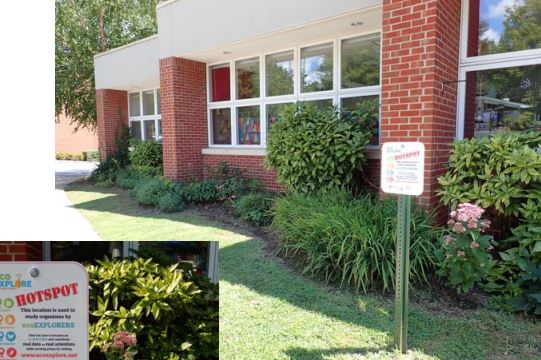
Hotspots at public libraries in Buncombe County. The development of the
hotspots served as the required community partnership project for the program.
The North Carolina Arboretum developed the ecoEXPLORE (Experiences Promoting Learning Outdoors for Research and Education) program that includes many county and state partners. EcoEXPLORE is an incentive-driven science enrichment program that engages third through eighth-grade students in both guided and self-directed citizen science activities. The arboretum partnered with the Buncombe County Public Library System to install an ecoExplore “Citizen Science HotSpot” at each of the 12 public libraries in the county. Baker served as the lead coordinator for the ecoExplore Hotspot at the West Asheville Library.

The project also helps the arboretum expand its mission to
cultivate connections between people and plants. Baker’s educational display at
the library and plant list were tailored for library patrons who are interested
in creating similar “hotspots” in their yards. She also worked with library
staff to lead a summer youth program that directly educated participants about
the topic of biodiversity. “The West
Asheville community is a very urban environment that is highly walkable and
includes a mixed population of young families, millennials, and retirees. The
library is located on a main road through the heart of West Asheville, and as
such, is extremely visible. Due to the site’s walkability and visibility and
the larger community interest in environmental awareness, it would be expected
that this site should attract a good deal of interest in the ecoEXPLORE
Hotspot,” said Baker.

When asked about her experience in the certification
program, Baker said she enjoyed networking with environmental educators across
the state. “We have so many talented and humble naturalists involved in this
program and it’s a great way to widen the community of passionate educators.
The exposure to resources, particularly curriculum guides, has helped me many
times as I’ve created programming for varied audiences.”
Baker said that the program taught her many different
methods for developing effective, hands-on and interactive lessons. “The
program helped expand my creativity, exposing me to lesson plans, games, and
artistic ways to convey environmental awareness and observations.”
Jonathan Marchal, youth education manager with the arboretum
said, “Meghan is an example of the type of outstanding educator and community
leader that we are fortunate to have found through our partnership with the DEQ
Office of Environmental Education and Public Affairs.”
Baker enjoys experiencing the ecology of agricultural
systems, and is continually working to maximize the potential of balancing
production demands with conserving biodiversity. She is particularly interested
in pollinators and the conservation of farm and wild lands.
Baker says the certification program has changed the way she
looks at environmental issues. “I would say that this certification program
helped me to present a more balanced view of environmental issues, providing me
with tools that broadened my environmental ethic beyond a personal experience
to a more holistic and approachable way of connecting to others.”
For more information about The North Carolina Arboretum’s
ecoEXPLORE program, visit the website at http://www.ncarboretum.org/education-programs/youth-family-programs/citizen-science/ecoexplore. For more information about the N.C. Environmental Education
Certification Program, visit http://www.eenorthcarolina.org
Certified Environmental Educator Baker Recognized by DEQ Secretary for Contributions to The North Carolina Arboretum’s ecoExplore Program
|
| Department of Environmental Quality Secretary van der Vaart presenting Meghan Baker with her Environmental Educator Certificate at The North Carolina Arboretum |
N.C. Department of Environmental Quality Secretary Donald van der Vaart made a special visit to the North Carolina Arboretum on Thursday to award Meghan Baker with a certificate for completing her North Carolina Environmental Education Certification.
Baker is an Extension Agent with Buncombe County Cooperative
Extension Service and provides educational outreach to small farmers, youth,
and community members in Buncombe County through field-based workshops during
the growing season and trainings in the winter.
She is among several certified environmental educators who
chose to partner with The North Carolina Arboretum to create ecoEXPLORE
Hotspots at public libraries in Buncombe County. The development of the
hotspots served as the required community partnership project for the program.
The North Carolina Arboretum developed the ecoEXPLORE (Experiences Promoting Learning Outdoors for Research and Education) program that includes many county and state partners. EcoEXPLORE is an incentive-driven science enrichment program that engages third through eighth-grade students in both guided and self-directed citizen science activities. The arboretum partnered with the Buncombe County Public Library System to install an ecoExplore “Citizen Science HotSpot” at each of the 12 public libraries in the county. Baker served as the lead coordinator for the ecoExplore Hotspot at the West Asheville Library.
The project also helps the arboretum expand its mission to
cultivate connections between people and plants. Baker’s educational display at
the library and plant list were tailored for library patrons who are interested
in creating similar “hotspots” in their yards. She also worked with library
staff to lead a summer youth program that directly educated participants about
the topic of biodiversity. “The West
Asheville community is a very urban environment that is highly walkable and
includes a mixed population of young families, millennials, and retirees. The
library is located on a main road through the heart of West Asheville, and as
such, is extremely visible. Due to the site’s walkability and visibility and
the larger community interest in environmental awareness, it would be expected
that this site should attract a good deal of interest in the ecoEXPLORE
Hotspot,” said Baker.
When asked about her experience in the certification
program, Baker said she enjoyed networking with environmental educators across
the state. “We have so many talented and humble naturalists involved in this
program and it’s a great way to widen the community of passionate educators.
The exposure to resources, particularly curriculum guides, has helped me many
times as I’ve created programming for varied audiences.”
Baker said that the program taught her many different
methods for developing effective, hands-on and interactive lessons. “The
program helped expand my creativity, exposing me to lesson plans, games, and
artistic ways to convey environmental awareness and observations.”
Jonathan Marchal, youth education manager with the arboretum
said, “Meghan is an example of the type of outstanding educator and community
leader that we are fortunate to have found through our partnership with the DEQ
Office of Environmental Education and Public Affairs.”
Baker enjoys experiencing the ecology of agricultural
systems, and is continually working to maximize the potential of balancing
production demands with conserving biodiversity. She is particularly interested
in pollinators and the conservation of farm and wild lands.
Baker says the certification program has changed the way she
looks at environmental issues. “I would say that this certification program
helped me to present a more balanced view of environmental issues, providing me
with tools that broadened my environmental ethic beyond a personal experience
to a more holistic and approachable way of connecting to others.”
For more information about The North Carolina Arboretum’s
ecoEXPLORE program, visit the website at http://www.ncarboretum.org/education-programs/youth-family-programs/citizen-science/ecoexplore. For more information about the N.C. Environmental Education
Certification Program, visit http://www.eenorthcarolina.org
Wednesday, August 31, 2016
Joann Blumenfeld – A Catalyst for Improving STEM Opportunities for High School Students with Disabilities
While earning her environmental education certification, Blumenfeld attended a workshop that inspired her to begin a new program called “Catalyst: Creating Opportunities in STEM for High School Students with Disabilities” through the Science House at North Carolina State University. “While I was attending a NCSU Sustainable Forestry Teacher’s Academy trip for teachers two summers ago, I was visiting a veneer factory near New Bern. The factory tour guide was explaining to us they brought in staff from Canada because they didn’t have local people who were industrial mechanics. The job required a particular two-year degree. It dawned on me that my students can do this and we as educators are not doing enough to align our curriculum and experiences for students for needed STEM jobs right here in North Carolina.”
Blumenfeld went
back home and wrote a grant to begin Catalyst which is now in its second year. “We
have so many students here with so many skills and so many STEM job opportunities
we have a hard time filling. We need more STEM and vocational programs to help
support students to reach their goals, as well as allowing them to consider a
wide range of STEM Career opportunities and educational pathways.”

The program involves one week-long training and eight Saturday sessions that include topics such as sustainable energy, forestry and pasture ecology. She currently has 22 students participating from 20 high schools. Her Catalyst students are finalists for the Lemelson-MIT InvenTeam, which awards high school students, teachers and mentors to invent technological solutions to real-world problems.

When asked
about her experience in the environmental education certification program,
Blumenfeld said, “The classes are best high-quality science content with
engaging lessons that have hands on affordable labs and activities I have
attended. I was able to meet many enthusiastic educators whom I learned from in
each session and also were very supportive who give me extra "energy"
to go back to the classroom and do even a better job. The classes were almost
all free which is important due to a teacher’s budget. I use the materials I
learned daily in my classroom to provide engaging lessons where the students
really understand the content. It has also helped them learn more about the
environment and how and why it is important for them to be good stewards of it.”
Blumenfeld
tries to encourage her students to look at all sides of environmental issues. “We
need to be good stewards of the earth but also provide jobs and products."
So it’s important for students to understand that it does not always need to be
an either/or but rather ‘how can we do this and be good stewards of the earth.’
We also have done global projects with other schools. One was a school in
Singapore on water usage. It allowed students to look through the global
stakeholder's lens on their values and environmental solutions and compare and
contrast them to their own. It also allowed the students to look at what is ‘needed’
in life and the environmental consequence of their choices. I think I have
instilled in my students it is important to be good stewards of the earth
through these engaging lessons and activities.”
Blumenfeld
hopes to engage more students in the Catalyst program so that they can be
successful in their current science classes, improve their science content and
skills and be exposed to a variety of STEM careers. “We help them to consider
different fields and educational pathways for their future,” she said.
Blumenfeld is
a National Endowment for the Humanities Scholar. She is also part of the North
Carolina Museum of Natural Sciences Education Forum and she serves on the North
Carolina Science Leadership Association Advocacy Committee. In addition, she is
a club advisor for STEM Cafe' at Broughton High School which meets weekly and
students learn about the STEM Content and Career opportunities.
If you have
high school students with disabilities either in Occupational Course of
Study(OCS) or the Regular Education Classes who are interested in STEM Careers,
Catalyst is a week long program with monthly Saturday Sessions during the
school year, located at the Science House at North Carolina State University.
The cost of the program is $50 for the summer session and the Saturday
Sessions. For more information, please contact Ms. Blumenfeld at: jblumenfeld@wcpss.net
To learn more about the Catalyst program, read Catalyst: Creating opportunities in
STEM for students with disabilities. For more information about the N.C. Environmental
Education Certification Program, visit the Office of Environmental Education
and Public Affairs’ website at www.eenorthcarolina.org
.
Thursday, July 28, 2016
CTNC AmeriCorps Member Larissa Lopez Making A Different through Education
By Reilly Henson Source: Conservation Trust for North Carolina (CTNC)
Larissa Lopez is serving with AmeriCorps, a ten-month national service program with positions offered by community and non-profit organizations. CTNC manages an AmeriCorps program that has placed 18 members with conservation and environmental groups throughout North Carolina. The program’s goals are to connect thousands of people to the outdoors and to develop future leaders in conservation. To learn more about CTNC’s AmeriCorps program, click here.
 Larissa Lopez is serving as Educational Outreach Coordinator for Balsam Mountain Trust, a non-profit that manages and protects the Balsam Mountain Preserve in Sylva, NC. Through the Adopt-A-School program, the Trust is able to provide educational programming to local elementary school students.
Larissa teaches kids about wild animals and pollinators. What makes her programs special is that her students get to see live animals, and participate in real citizen science. Her younger students in the 1st and 2nd grades get to learn about pollinators, especially monarch butterflies, while her older students in the 4th and 5th grades get to see snakes and hawks.
“We visit classrooms multiple times during the year and at different grade levels,” says Larissa. “This format allows for deep student engagement with Balsam Mountain Trust staff and our animal ambassadors. It is a unique opportunity to observe the students’ change in knowledge and behavior over time.”
 Although teaching hasn’t always been one of her primary interests, Larissa has come to realize how important outreach and education are for environmental non-profits. She already had plenty of experience in land management and resource stewardship, so she sought to use her AmeriCorps service term as an opportunity to round out her knowledge in an educational capacity. “Working in the non-profit sector often means being a ‘Jack-of-all-trades,’ so I feel strongly about assuming a variety of responsibilities.”
Education may be only one of many components of environmental work, but it does have its own rewards. “Being an informal educator allows me to engage directly with the public, spark a curiosity and passion for conservation in children, further my knowledge of the natural world, and polish my attentiveness to detail in planning, all important and rewarding experiences.”
After she completes her service term, Larissa hopes to find a career that combines her interests in land management and public engagement. “I am passionate about sustainable and ethically derived foods, so I have been looking to get involved with community gardens and school garden projects. These projects get students outside to observe nature and learn about the importance of caring for our natural resources.”

Larissa Lopez is serving with AmeriCorps, a ten-month national service program with positions offered by community and non-profit organizations. CTNC manages an AmeriCorps program that has placed 18 members with conservation and environmental groups throughout North Carolina. The program’s goals are to connect thousands of people to the outdoors and to develop future leaders in conservation. To learn more about CTNC’s AmeriCorps program, click here.

Larissa teaches kids about wild animals and pollinators. What makes her programs special is that her students get to see live animals, and participate in real citizen science. Her younger students in the 1st and 2nd grades get to learn about pollinators, especially monarch butterflies, while her older students in the 4th and 5th grades get to see snakes and hawks.
“We visit classrooms multiple times during the year and at different grade levels,” says Larissa. “This format allows for deep student engagement with Balsam Mountain Trust staff and our animal ambassadors. It is a unique opportunity to observe the students’ change in knowledge and behavior over time.”

Education may be only one of many components of environmental work, but it does have its own rewards. “Being an informal educator allows me to engage directly with the public, spark a curiosity and passion for conservation in children, further my knowledge of the natural world, and polish my attentiveness to detail in planning, all important and rewarding experiences.”
After she completes her service term, Larissa hopes to find a career that combines her interests in land management and public engagement. “I am passionate about sustainable and ethically derived foods, so I have been looking to get involved with community gardens and school garden projects. These projects get students outside to observe nature and learn about the importance of caring for our natural resources.”

Friday, July 22, 2016
Gonna Catch EE? Augmented Reality Games and Environmental Education

Probably like many others in environmental education and related fields, we had not heard that much about Pokemon Go until a few weeks ago. Then suddenly we were scrambling to learn more about it and how it may affect educational facilities and programs.
It all started on July 8th with a #NCNatureFriday tweet about the N.C. Museum of Art Park. We had no idea what a Pokestop was...So we looked it up and thought, "Hmmm, what effect will this game have on nature centers, parks, science museums and environmental education programs?" Will it be the next geocaching?" We had no idea it would catch on so quickly.
The following Monday, probably half or more of the Tweets in our feed were about Pokemon Go. And it didn't take parks, museums, gardens, nature centers and other sites associated with environmental education and outdoor exploration to recognize the potential of, or at least the need to address, the new phenomenon.
Many sites are trying to work with the Pokemon Go craze in positive ways - keeping within their mission and combining the interest in the game with connections to real nature. But of course, there are the obvious concerns of even more technology coming between individuals and the natural world. Also, what will be the impact of visitors coming to parks, nature centers, and other outdoor educational venues to play the game?
We wanted some perspectives on the game from some North Carolina venues, so we did an informal survey of North Carolina environmental education centers (which includes parks, museums, botanical gardens, etc).
Thursday, July 14, 2016
Educator Spotlight - Erin Apple

Erin Apple recently completed her N.C. Environmental
Education Certification. Apple works as a park technician of programs at Harris
Lake County Park and the American Tobacco Trail designing, marketing and
leading a full calendar of public and group programs, outreach efforts and
special events in Wake County.
In addition to her programming, Apple works with volunteers and assists with park operation, customer service and natural resource management such as removal of invasive species and prescribed burning. When she isn’t
working, Apple enjoys hiking, kayaking, yoga, writing and gardening.
 For her community partnership project, Apple designed, built
and narrated an interactive public display on plant photorespiration for the N.C.
Museum of Natural Sciences’ Natural World Investigation Lab. The project, which is still on rotating
display in the museum, added to their archive of public displays and educates museum visitors (homeschoolers, school groups and the general public)
about the botany and the complexity of plants on both a cellular and environmental
level.
For her community partnership project, Apple designed, built
and narrated an interactive public display on plant photorespiration for the N.C.
Museum of Natural Sciences’ Natural World Investigation Lab. The project, which is still on rotating
display in the museum, added to their archive of public displays and educates museum visitors (homeschoolers, school groups and the general public)
about the botany and the complexity of plants on both a cellular and environmental
level.
Apple had many valuable experiences during her certification process. “Traveling to workshops was always such a rewarding experience,
it's hard to pick just one favorite part, but I would have to say I enjoyed the
Advanced WILD (offered through the Wildlife Resources Commission) workshops and
especially the Rare Plants of North Carolina workshop (offered through NCSU)
the most," noted Apple. While I teach kids more than any other group, I thoroughly enjoy
working with adults, and I most enjoy attending workshops that teach more
advanced scientific material - it's refreshing and important to continually
expand my ecological knowledge after completing my degree.”
Apple also mentioned the Methods of Teaching Environmental
Education workshop, which is required for all enrollees. “I really felt like I was going somewhere with my
certification after completing the Methods workshop and that I had gained a lot
of the valuable insight this certification aims to provide. I brought what I
learned into my teaching,” she said.
In addition to the benefits from instructional workshops such
as Project WET which focuses on the way people use water resources, Apple noted
that the practical applications were valuable. “Practicing activities at
workshops with other educators and learning their methods, trials, failures and
successes helped me to see where I needed improvement and how to better myself
as an educator. I was also able to share my own experiences thus far in my
young career, and I believe the certification helped me to learn the best ways
to more effectively reach a variety of audiences,” said Apple.
For more information about Harris Lake County Park visit the park's website . For more information about the Office of Environmental Education and Public Affairs or the N.C. Environmental Education Certification Program visit www.eenorthcarolina.org
Subscribe to:
Posts (Atom)