Thursday, July 19, 2012

Raleigh Teens Competed in National Canon Envirothon Competition...

Asheville, NC had the honor of hosting the 2009 Canon Envirothon!

Well, as you know from the story above, our North Carolina Team did quite well! We decided to leave this story as it gives some background information on N.C. Envirothon. We have also added a few Envirothon facts the Wake Soil and Water Conservation District and Steve Bennett, state Envirothon Coordinator with the NCDA&CS Division of Soil and Water Conservation sent us:

*The North Carolina Envirothon began in 1991 and celebrated its 20th Anniversary last year in 2011.

*This summer's 2012 Canon Envirothon marked the environmental education program's 25th Anniversary.

*The N.C. Envirothon has hosted the North American Canon Envirothon twice in Asheville.

*North Carolina is 2nd only behind Pennsylvania for having the most teams score consistently in the Top 10 over the Envirothon's 25 years!

*North Carolina had the first blind and low vision team in the nation compete in a regional Envirothon. The "Green Knights" from the Governor Morehead School for the Blind in Raleigh competed at the 2011 Area 4 Envirothon in Bunn, NC. 


Previous story: North Carolina's 2012 state champion Envirothon team, Enloe High School's "Sub-Chronic Exposure," is on their way to the National Canon Envirothon competition. Teams from 45 states and 9 Canadian provinces will compete in this academic contest which requires a comprehensive knowledge of several environmental topics and issues. This year's focus is nonpoint source pollution and low impact development. The competition is July 22-27 at Susquehanna University in Selinsgrove, Pennsylvania. In 2009, it was hosted on the campus of UNC Asheville.

You can read more about the team on the Friends of Wake County Soil and Water Conservation District blog.

The N.C. Office of Environmental Education and Public Affairs is proud to support the efforts of N.C. Envirothon. Congratulations to all the North Carolina competition winners! Second place went to "D C Endemic," a homeschool group from Davidson county, and third place went to the Durham 4-H "Natural Disasters."

The Canon Envirothon is North America's largest environmental education competition for high school students. In North Carolina, Envirothon is sponsored by the state’s 96 local soil and water conservation districts and their association, with organizing support from the N. C. Division of Soil and Water Conservation. N.C. Environthon offers competitions for both high school and middle school students and also offers trainings each summer for Envirothon team advisors. To find out how to participate, visit http://www.ncenvirothon.org/ or contact your local soil and water conservation district.

Monday, July 16, 2012

Environmental Educator Named Tar Heel of the Week

Renee with her husband Scot Pressley
Renee Strnad, an environmental educator for N.C. State University Extension Forestry and the state Project Learning Tree coordinator was named Tar Heel of the Week by the News & Observer for her accomplishments as an environmental educator. 

Renee is a N.C. Certified Environmental Educator and currently serves as the President of Environmental Educators of North Carolina. She was recently awarded Project Learning Tree Gold Star Award, the highest honor bestowed by PLT to a PLT program coordinator in recognition of their years of exemplary service to Project Learning Tree.

Congratulations to Renee! Go here to read the story

Thursday, July 12, 2012

Grandfather Mountain Director of Education and Natural Resources Receives National Honor


Congratulations to Jesse Pope! Jesse is a North Carolina Certified Environmental Educator and serves as the current past president on the board of the N.C. Association of Environmental Education Centers. It is noteworthy that a tourism industry group recognized a career environmental educator for this honor!

More details in the press release below from the Grandfather Mountain Stewardship Foundation:


GRANDFATHER MOUNTAIN, NC-- The Grandfather Mountain Stewardship Foundation is proud to announce that Director of Education and Natural Resources, Jesse Pope has been selected as a member of the "Forty for the Future," travel's leading talent project by the Southeast Tourism Society.

The purpose of the award is to recognize 40 young professionals under the age of 40 from across the country in the tourism industry.  The goal is to highlight certain younger professionals whose work and commitment to travel and tourism has made a positive difference.

Jesse Pope came to Grandfather in 2002 as a wildlife keeper and backcountry ranger.  In 2004, Pope's extraordinary knowledge and friendly demeanor led management to ask him to develop a Naturalist program for Grandfather Mountain.     

During his tenure as Chief Naturalist, Pope took the program from the seed of an idea to the experience that visitors report adds the most value to a visit.  In 2010, he was named Director of Education and Natural Resources, managing three full time and three part time employees.

As Director of Education and Natural Resources for the Stewardship Foundation, Jesse develops and oversees educational experiences, conservation efforts, and resource management; ensures that educational programming aligns with GMSF's mission and state and national guidelines for environmental education; oversees all aspects of education, including formal and non-formal programs, and guided hikes; promotes GMSF's efforts to the public and to the educational and biological communities.

"Pope is the most knowledgeable person on the mountain about most anything in his field: birding, plant identification, the characteristics of distinct Appalachian ecological communities, trail maintenance, high angle search and rescue, opening cars when the keys have been locked inside and much more," said Penn Dameron, president of the Grandfather Mountain Stewardship Foundation.

He is certified in everything from Environmental Education to National Park Service Eastern High Angle Rescue and is currently enrolled in a Masters program for Environmental Education at Montreat College.  The vast spectrum of knowledge Pope has acquired through his educational background and his 10 years of experience meld with his naturally gregarious personality to make him a truly unique educator. All of Grandfather Mountain is his classroom.

For more information about Southeast Tourism Society and the "Forty for the Future Award," please visit the Southeast Tourism Society website at www.southeasttourism.org.

The Grandfather Mountain Stewardship Foundation is a not-for-profit corporation established to preserve Grandfather Mountain, operate the nature park sustainably in the public interest, provide an exceptional experience for guests and inspire them to be good stewards of the earth's resources.  For more information, visit www.grandfather.com or call 800-468-7325.

NCSU Researchers Visit Environmental Literacy Center to Test Environment-based Learning Game


Guest post by Deja Smith, N.C. Office of Environmental Education and Public Affairs Summer Intern
A group of researchers from North Carolina State University Department of Computer Science recently visited the Environmental Literacy Center to test their prototype video game, “Future Worlds.” The scientists collaborated with a group of middle school summer campers from the Museum of Natural Sciences’ Investigate Lab camp to test the prototype. The principal investigators on the project are Jonathon Rowe, James Lester, Brad Mott, Eleni Lobene, James Minogue and Marc Russo. 

Future Worlds is an interactive cyberlearning tool explores the causes and effects of different factors on environmental systems and how human actions can have negative and positive effects on the environment.  The layout is planned to be in “Sim City” style where the participant is an outside user controlling different environmental factors and examining those effects on the environment.

The campers worked with a paper prototype of the game as well as a Microsoft Surface 40” multi- touch computer table.  Phrases such as “This is awesome!” “Wow this is so cool!” “I can’t wait to show my friends this” and “I learned a lot, but still had fun” were heard throughout the room. Future Worlds is still in its beginning stages and is expected to be completed in 2013. It is set to be an interactive exhibit in the N.C. Museum of Natural Sciences the same year.   

The Environmental Literacy Center is operated by the N.C. Office of Environmental Education and Public Affairs and is located on the 3rd floor of the Museum of Natural Sciences Nature Research Center in Raleigh.  The center is open to educators by appointment to use for environmental education-related research, small meetings and other work sessions. Contact the N.C. Office of Environmental Education for details.


Monday, June 25, 2012

Sturgeon City Holds First Program Alumni Event

Photo of Sturgeon City Alumni  from www.jdnews.com See more great photos of the alumni in the story's photo gallery!

Sturgeon City, a unique environmental and civic education center in Jacksonville, NC, recently held its first program alumni homecoming. Several individuals shared remembrances of the environmental education programs they participated in as middle school and high school students and described how Sturgeon City has positively impacted their lives, their community and the local environment.

The Jacksonville Daily News quotes Brandon Fresia, who was in Sturgeon City's first program in 1999: "To feel like I was doing something for the community in the future, that I would actually have a say-so in something that was going to be pretty big was huge for me. Thirteen years later (Sturgeon City) has moved 100 times fold from where it started ... so just to imagine where it’s going to be at it in another 10 years makes me excited." Read more about Sturgeon City, the alumni and their experiences in the Jacksonville Daily News, Sturgeon City Welcomes Back Alumni.

Sturgeon City is on the site of the city's former wastewater treatment plant. Several of the original structures remain and some house their environmental education programs. Sturgeon City's story is just as unique as its facilities. For more than 40 years, the City of Jacksonville discharged its wastewater into the New River. In 1997, the City moved to an environmentally friendly and expandable land application treatment system which stopped discharging the treated effluent into the river. Residents were concerned about the severely degraded condition of the waterway and the Jacksonville City Council determined that it was their moral responsibility to help clean up the area where the City’s discharge had occurred. An initiative was created that used bioremediation to help jump-start natural processes. Students volunteered to help and became excited about being part of something that effected a positive change they could see. Further, many were excited about the science being used, about working alongside field scientists and about the power of volunteerism. Their enthusiasm inspired a community to transform the former wastewater treatment plant that had contributed to the problem to stand as a reminder of the civic action that overcame a degraded river and to be a force for the future to protect the river and other natural resources.


North Carolina Loses Great Friend and Supporter of Environmental Education

Joe C. Hogue Jr., a strong supporter of environmental education in North Carolina, recently passed away at age 69. Joe worked for more than 30 years with the North Carolina Forest Service and played a key role in the development of the state's educational state forests. Joe later became the N.C. Forest Service's Information & Education Chief and was a key figure in the development of the N.C. Environmental Education Certification Program in the early 1990s. Joe continued to play an active part in the EE Certification Program and in environmental education as a whole until his retirement in 2002. Even after his retirement, it was not unusual for Joe to drop by the Office of Environmental Education and Public Affairs or at environmental education gatherings around the state. He will certainly be missed. Joe's complete obituary is available here.  

Friday, June 22, 2012

N.C. Certified Environmental Educator Recognized by Virginia DEQ Environmental Educators Leadership Program


George Jefferson, an assistant park ranger at Hanging Rock State Park and a North Carolina Certified Environmental Educator, was recently recognized by the Virgina Department of Environmental Quality Environmental Educators Leadership Program (EELP) as an Environmental Education Leader. This is the highest level of recognition in the EELP. George's recognition is very appropriate as he conducts environmental education programs in both states. He is also a Virginia Master Naturalist and a trained facilitator for several Virginia-based environmental education programs. Congratulations George! You can read more about George and other N.C. Certified Environmental Educators at http://certifiedenvironmentaleducators.blogspot.com/

Thursday, May 31, 2012

North Carolina Environmental Educator Receives Project Learning Tree® Gold Star Award


Congratulations to Renee Strnad, the North Carolina Project Learning Tree Coordinator, on winning the Project Learning Tree Gold Star Award! Renee is a N.C. Certified Environmental Educator and has served as an  essential partner with the N.C. Office of Environmental Education and Public Affairs in the development of the N.C. Environmental Literacy Plan and the N.C. Environmental Education Certification Program. Read more about Renee and her work in the PLT press release below:

Washington, D.C. – Project Learning Tree® (PLT), the environmental education program of the American Forest Foundation, honored Renee Strnad, North Carolina Project Learning Tree Coordinator with NC State University - Extension Forestry, with a PLT Gold Star Award.  The PLT Gold Star Award is the highest honor bestowed by PLT to a PLT program coordinator or partner in recognition of their years of exemplary service to Project Learning Tree. 

Kathy McGlauflin, Director of Project Learning Tree and Senior Vice President of Education with the American Forest Foundation, presented the award to Strnad on May 17 during PLT’s 26th International Coordinators’ Conference in Deadwood, South Dakota. 

“Renee’s passion for environmental education and for inspiring students and teachers is contagious,” said McGlauflin.  “Her unflagging support of PLT since early in 2000 has provided thousands of educators in North Carolina with professional development and curriculum support to help engage their students in learning about the natural world, forests, and the importance of stewardship.  She finds creative ways to engage people of all ages in learning about the environment and is a true believer that you should ‘be the change you wish to see in the world.’”

Strnad came to North Carolina after graduating from Kansas State University in Manhattan, Kansas in 1997 with a dual Bachelor of Science degree in Wildlife Biology and Natural Resources and Environmental Sciences.  She was drawn initially to the Outer Banks by an environmental education position and within the year she relocated to Raleigh and NC State University where she is the Environmental Educator for Extension Forestry in the College of Natural Resources and North Carolina PLT coordinator.

PLT provides educators with the tools they need to bring the environment into the classroom and their students into the environment.  PLT’s curriculum materials cover topics ranging from forests, wildlife, and water, to community planning, waste management and energy.  The curriculum meets national and state education standards, including the North Carolina Standard Course of Study for grades K-8 in language arts, math, science, and social studies.

Strnad has been a certified environmental educator in North Carolina since 2003.  She coordinates teacher professional development, as well as classroom programs and field activities for K-12 students.  She supports 4-H natural resource programs statewide and serves as a liaison between the College of Natural Resources at NC State University and environmental educators.  She also coordinates forestry institutes each summer for educators -- one on the coast and one in the mountains.

“I play in the woods, teach about the woods, and increase the knowledge of teachers and students like,” says Strand of herself.  “A personal passion is ensuring that people understand the ecology and importance of forest fires in maintaining forest health in our state,” says Strnad.

Strnad also helps citizens better understand issues surrounding solid waste.  She developed a workshop series on municipal solid waste in cooperation with North Carolina’s office of Environmental Assistance and Outreach.  She serves her community as a member of the Board of Directors for the Scrap Exchange, a non-profit creative reuse center, based in Durham, whose mission is to promote creativity, environmental awareness, and community through reuse.
Since 2008, Strnad has been a key player in efforts to align North Carolina’s state standards with national environmental literacy guidelines.  She was instrumental in acquiring the first funding to support implementation of the N.C. Environmental Literacy Plan through a baseline study of environmental literacy in North Carolina students.

In 2009 Strnad was the winner of the Environmental Educators of North Carolina award for Outstanding Service, and she currently serves as President for the group.  In 2011, she received the North Carolina Wildlife Federation’s Environmental Educator of the Year award.

Strnad also supports national environmental education efforts through her work with the North American Association of Environmental Education (NAAEE), and last year she chaired NAAEE’s Volunteer Committee for their annual conference that was held in Raleigh in October.  She is currently serving as President of Environmental Educators of North Carolina, which is the NAAEE Affiliate in North Carolina. 

Wednesday, May 30, 2012

N.C. Environmental Education Center Becomes First State Attraction to Join NC GreenTravel Initiative

Grandfather Mountain, one of the state's recognized "N.C. Environmental Education Centers," recently became the first attraction to join and become certified to the NC GreenTravel Initiative, a program that recognizes state travel-related businesses that employ healthy environmental practices. The N.C. Division of Environmental Assistance and Outreach – in partnership with the Center for Sustainable Tourism at East Carolina University and the Division of Tourism, Film and Sports Development in the N.C. Department of Commerce – launched the NC GreenTravel Initiative earlier this year to spotlight the state’s commitment to sustainable practices and to recognize businesses that have integrated greener practices into their daily routine.

Grandfather Mountain has long been dedicated to environmental education for visitors as well as schools, civic groups and many others. Over the last several years, they have also integrated their dedication to EE with a commitment to sustainably. This has included generating its own green power through an array of photovoltaic cells; using solar thermal panels to heat the water and supply radiant heat in Grandfather’s Fudge Shop; and using 100 percent compostable and biodegradable plates, cups, forks, spoons, knives and take-out containers in its Nature Museum Restaurant. Recycling bins for aluminum and plastic can also be found in different locations throughout the park.

Read the entire N.C. DENR Press Release for more details as well as contact information for the NC GreenTravel Program.

N.C. Teacher Wins Presidential Innovation Award for Environmental Educators!

Frank McKay, a teacher at Exploris Middle School in Raleigh, has been awarded one of 18 Presidential Innovation Awards for Environmental Educators.  This award recognizes outstanding K-12 teachers for excellence in integrating environmental education into their lessons and connecting students with their communities and the natural world. The award is sponsored by the White House Council on Environmental Quality in partnership with the U.S. Environmental Protection Agency.

Exploris is an urban charter school with no school grounds or outdoor classroom spaces, but Frank has worked with many community partners and local and state agencies to find environmental education experiences for his students, including the City of Raleigh's Walnut Creek Wetlands Center.  (Here is more about Frank's work at Exploris).

For more information about the award program, visit the PIAEE page on the EPA website.

Congratulations Frank!

Thursday, May 24, 2012

Meet North Carolina Certified Environmental Educators!

For several years the N.C. Office of Environmental Education and Public Affairs has featured profiles of individuals certified through the N.C. Environmental Educator Certification Program. We recently moved all of the past profiles to a new blog format. Check them out at http://certifiedenvironmentaleducators.blogspot.com/

You can also access the profiles from the main EE Certification site, which lists all N.C. Certified Educators by county. http://www.eenorthcarolina.org/certification--meet-certified-educators.html

The North Carolina Environmental Education Certification Program recognizes professional development in environmental education and acknowledges educators committed to environmental stewardship. This 200-hour program establishes standards for professional excellence in environmental education for formal and non-formal educators. It consists of workshops, field experiences, teaching experiences and and environmental education community partnership project.

To more about the program, including the enrollment process, are available at http://www.eenorthcarolina.org/certification--about-the-program.html


Tuesday, May 15, 2012

EECapacity Seeks to Enhance Environmental Education in Urban Communities


A training focused on addressing environmental education in urban communities took place the week of May 15th in Washington, DC. This project stems from a five-year Environmental Protection Agency environmental education professional development program grant that was awarded to the Cornell University Civic Ecology Lab. The EE Capcity program "seeks to redefine environmental education practice within the context of an increasingly urban society" and will also research the role of new social networks in creating innovative educational practices.

Though the training has ended, the program continues and Twitter users can still continue the discussion with the hashtag #eecap. For a detailed story on the EE Capacity project, read this piece in the Cornell Chronicle. Photo from Cornell Chronicle.

Thursday, May 3, 2012

Eleven N.C. Colleges Make Princeton Review's "Green Colleges" Guide


The Princeton Review, in collaboration with the Center for Green Schools at the U.S. Green Building Council, released its third annual edition of "The Princeton Review's Guide to 322 Green Colleges: 2012 Edition" in April. Eleven North Carolina colleges made the list this year!

Appalachian State University
Catawba College
Duke University
Elon University
Guilford College
North Carolina State University
University of North Carolina at Asheville
University of North Carolina at Chapel Hill
Wake Forest University
Warren Wilson College
Western Carolina University

"The Princeton Review's Guide to 322 Green Colleges: 2012 Edition" profiles 322 institutions of higher education in the United States and Canada that demonstrate notable commitments to sustainability in their academic offerings, campus infrastructure, activities and career preparation. The 232-page book—the only free, comprehensive, annually updated guide to green colleges—can be downloaded at www.princetonreview.com/green-guide  and www.centerforgreenschools.org/greenguide. The Guide was developed with generous support from United Technologies Corp (www.utc.com), founding sponsor of the Center for Green Schools. (From the Princeton Review Press Release)

Congratulations again to the eleven, but we know many more North Carolina four-year, two-year and community colleges are doing great work in environmental education, sustainability and green-jobs workforce development. We'll try to feature more of those in EE News Tips and in the "EE College" tag on our Delicious feed.  


Monday, April 23, 2012

Two N.C. Schools Named U.S. Department of Education Green Ribbon Schools


Congratulations to Evergreen Community Charter School in Asheville and American Hebrew Academy in Greensboro for being named two of the first U.S. Department of Education Green Ribbon Schools! Read more about this new program in the press release below:

Obama Administration Names 78 Schools in 29 States and D.C. as First-Ever U.S. Department of Education Green Ribbon Schools

Winners Represent a Diverse Portfolio of Schools, Includes 66 Public and 12 Private Schools in Urban and Rural Communities

U.S. Secretary of Education Arne Duncan was joined today by White House Council on Environmental Quality Chair Nancy Sutley and Environmental Protection Agency Administrator Lisa Jackson to announce the first-ever U.S. Department of Education Green Ribbon Schools, a list including 78 schools that span 29 states and D.C.

The announcement was made during a visit to Stoddert Elementary School, one of D.C.’s two honorees.

“Science, environmental and outdoor education plays a central role in providing children with a well-rounded education, helping prepare them for the jobs of the future,” said U.S. Secretary of Education Arne Duncan. “U.S. Department of Education Green Ribbon Schools demonstrate compelling examples of the ways schools can help children build real-world skillsets, cut school costs, and provide healthy learning environments.”

U.S. Department of Education Green Ribbon Schools (ED-GRS) is a federal recognition program that opened in September 2011. Honored schools exercise a comprehensive approach to creating “green” environments through reducing environmental impact, promoting health, and ensuring a high-quality environmental and outdoor education to prepare students with the 21st century skills and sustainability concepts needed in the growing global economy.

"Schools that take a green approach cut costs on their utility bills, foster healthy and productive classrooms, and prepare students to thrive in the 21st century economy," said Nancy Sutley, Chair of the White House Council on Environmental Quality. "These Green Ribbon School award winners are taking outstanding steps to educate tomorrow's environmental leaders, and demonstrating how sustainability and environmental awareness make sense for the health of our students and our country."

The 78 awarded schools were named winners from among nearly 100 nominees submitted by 30 state education agencies, the District of Columbia and the Bureau of Indian Education. More than 350 schools completed applications to their state education agencies. Among the list of winners are 66 public schools including 8 charters, and 12 private schools composed of 43 elementary, 31 middle and 26 high schools with around 50 percent representing high poverty schools.

"These Green Ribbon Schools are giving students and educators what they need to maximize learning and minimize risks like asthma and other respiratory illnesses, ensuring that no child is burdened by pollution in or around their school," said EPA Administrator Lisa P. Jackson. "Today's winners are protecting our children's health and opening up environmental education opportunities for students. The EPA is proud to help recognize the Green Ribbon award winners and will continue working to improve the environment of our nation’s schools and helping prepare students to succeed in the emerging green economy.”

The U.S. Department of Education’s “Green Ribbons” are one-year recognition awards. Next year’s competition will open in summer 2012. State agencies are encouraged to send their intents to submit nominees by June 15, 2012 via email to green.ribbon.schools@ed.gov .

Connect with more U.S. Department of Education Green Ribbon Schools resources.

Read all U.S. Department of Education Green Ribbon Schools blogs.
###

Wednesday, March 28, 2012

EE Week 2012 Greening STEM Planning Toolkits Available


EE Week is coming soon! National Environmental Education Week (EE Week) is the nation's largest environmental education event held each year the week before Earth Day. EE Week inspires environmental learning and stewardship among students by connecting educators with environmental resources to promote K-12 students' understanding of the environment. EE Week is a program of the National Environmental Education Foundation.

EE Week's 2012 theme is Greening STEM: The Environment as Inspiration for 21st Century Learning. The environment is a compelling context for teaching STEM (Science, Technology, Engineering and Math) as it provides educators with a diverse range of real-world challenges that engage students in hands-on opportunities to apply and reinforce STEM concepts across multiple subject areas.

EE Week "toolkits" lay out a set of activities and resources in five popular environmental topic areas that incorporate elements of STEM. Some activities and resources also include project-based learning, service-learning and citizen science components.

See the EE Week website for the toolkits and complete details. Be sure to register your organization or school for EE Week as well!

Friday, March 23, 2012

N.C. Environmental Literacy Plan Available for Public Input


The comment period has closed. The N.C. Office of Environmental Educationa and Public Affairs and the ELP Working Group are currently reviewing the public comments and feedback.

A copy of the most recent draft is available at http://www.eenorthcarolina.org/educators--literacy-plan.html

The N.C. Department of Environment and Natural Resources, the N.C. Department of Public Instruction and numerous partners have developed this plan for North Carolina to enhance environmental literacy among public school students. It will serve as a guiding document in integrating environmental education as a method of enhancing instruction across the curriculum. It addresses educational standards and measuring environmental literacy, teacher professional development opportunities and the importance of buildings and grounds as part of an effective learning experience. For more details on the history of the plan, see http://www.eenorthcarolina.org/educators--literacy-plan.html

The Office of Environmental Education and Public Affairs would like to thank members of the Environmental Literacy Plan Working Group http://www.eenorthcarolina.org/ELP-members.html for their time and energy in developing this plan and the N.C. Department of Public Instruction for their partnership and support.

N.C. Environmental Education Centers Dominate Top 30 N.C. Attractions List. Again!

Not just a pretty face--Grandfather Mountain also provides a multitude of environmental education programs to the public, as do many of the other top 30 N.C. Attractions.

Each year, Carolina Publishing Associates, the Matthews-based publisher of the Carolina Heritage Guide, Carolina Field Trips Magazine and the African American Heritage and Visitor's Guide, releases its much-anticipated list of top North Carolina museums and historic attractions. Facilities that are also designated as North Carolina Environmental Education Centers have long dominated the list, and this year is no exception with 17 out of the top 30. These facilities are considered environmental education centers because they offer educational exhibits and programming about nature or other aspects of the environment. Learn more about N.C. Environmental Education Centers.

Facilities listed as N.C. Environmental Education Centers noted in bold.
Read the full story in PR Newswire

The Triangle Business Journal has a beautiful photo gallery of the attractions as well!

(Just a little side note--though not listed as an EE Center, Biltmore has a long history of fostering forestry education! Read more on the Biltmore Estate Forestry page.)
1. Biltmore, Asheville, 1,101,413.
2. Fort Macon State Park, Atlantic Beach, 757,700.
3. Discovery Place, Charlotte, 745,060.
4. NC Museum Of Natural Sciences, Raleigh, 712,313.
5. North Carolina Zoo, Asheboro, 694,929.
6. Fort Fisher State Historic Site, Kure Beach, 601,366.
7. Marbles Kids Museum, Raleigh, 546,799.

8. Wright Brothers National Memorial, Kill Devil Hills, 485,622.
9. Museum of Life and Science, Durham, 446,874.
10. North Carolina Aquarium at Fort Fisher, Kure Beach, 411,487.
11. North Carolina Aquarium at Pine Knoll Shores, 381,948.
12. North Carolina Arboretum, 367,083.
13. North Carolina Museum of Art, 363,246. (The Art Park trails and grounds)
14. Natural Science Center of Greensboro, 319,076.

15. North Carolina Museum of History, 292,789.
16. Fort Raleigh National Historic Site, 283,478.
17. North Carolina Maritime Museum, 292,789.
18. North Carolina Aquarium at Roanoke Island, 256,186.
19. Grandfather Mountain, 245,000.

20. NASCAR Hall of Fame, 216,630.
21. Battleship North Carolina, 199,498.
22. Tryon Palace, 175,853.
23. Chimney Rock State Park, 170,994.
24. Linville Caverns, 169,830.
25. Cherokee Cultural District, 166,747.
26. The Billy Graham Library, 163,919.
27. The Mint Museum, 149,000.
28. Airborne and Special Operations Museum, 144,289.
29. Catawba Science Center, 141,969.
30. Morehead Planetarium and Science Center, 140,000.

Wednesday, March 21, 2012

Several New Grants Posted!

Several new grants have just been posted to the EE Grants page! There are a wide variety currently listed, including many that are related to school gardens, food programs and general outdoor learning environments.


PLT GreenSchools! Grant, one of many currently listed on our website.

Thursday, February 16, 2012

EE Certification Community Partnership Helps Community Gardens Bloom

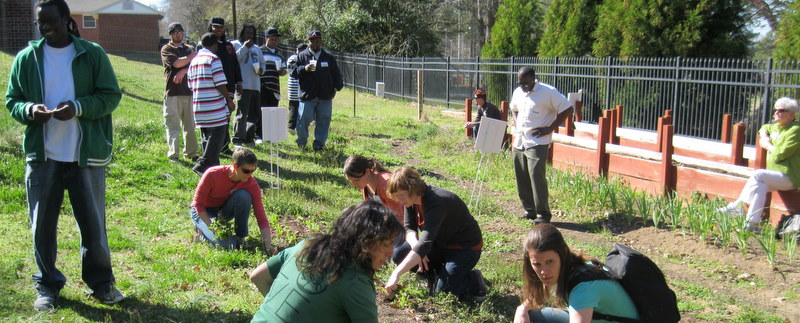
Over the years, several enrollees in the N.C. Environmental Education Certification Program have installed schoolyard and community gardens as their required community partnership projects. Gardens like these have become an increasingly popular way to provide environmental education, promote physical activity and increase the availability of fresh, locally grown food. However, good garden management and maintenance is essential to the success of this type of garden. Cindy Lincoln, an educator at the Walnut Creek Wetlands Center in Raleigh, saw this as an opportunity to to help her community as well as communities across the Triangle and possibly the entire state.

For her Environmental Education Certification Community Partnership Project, Cindy created comprehensive and easy-to-use garden maintenance training materials for local community gardeners. Her project required extensive research which included visits to several community gardens in the area to assess their training needs. She also partnered with the Inter-Faith Food Shuttle, which will be the first community garden to implement her training materials. Cindy plans to volunteer and assist other community gardens in the area with her resources.

The Environmental Education Community Partnership Project is one of five required criteria areas in the N.C. Environmental Education Certification Program, which is managed by the N.C. Office of Environmental Education and Public Affairs. The purpose of the project is to provide EE Certification candidates with the opportunity to lead a partnership that has a positive effect on the community and increases environmental awareness and understanding.


Photo from Inter-Faith Food Shuttle, Raleigh: http://www.foodshuttle.org/

Wednesday, February 15, 2012

UNCG Students' Environmental Education Certification Projects Teach Kids about Food, Health and Growing Things


Allyson Cates and Erin Hottle, both pre-service teachers at UNC Greensboro, were recently featured by the Guilford County Cooperative Extension School Garden Network and the North Carolina Community Garden Partners for their greenhouse and garden project at General Green Elementary. Cates and Hottle are also enrolled in the N.C. Environmental Education Certification Program. Different aspects of the greenhouse and garden project are serving as each of their community partnerships, which is a required critieria for the EE Certification Program. 

Their projects involve refurbishing an existing greenhouse at the school, growing and planting seedlings with the students and developing lessons and curricula the teachers can use with students when the project is complete. Project partners include the Guilford County Cooperative Extension School Garden Network and The Giving Seed Sustainable Farm, a nonprofit that connects young people with their environment through hands-on gardening and environmental education programs.

Several other UNCG pre-service teachers are participating in the N.C. EE Certification program as well. Other community projects include school gardens, nature trail restorations and projects that integrate language arts, math, science, art and other subjects with environmental education.